Normally, today, January 16th, I would be in Thailand at Wat Pah Pong for the annual remembrance of the late, great Ajahn Chah, the teacher under whose guidance I spent my formative years as a monk. After a long illness, for ten years of which he was practically paralysed and physically helpless, Ajahn Chah died on January 16th, 1992. He was seventy-three. A year later on the first anniversary of his death he was given a state funeral in the presence of the King and the Queen, the Prime Minister and all sorts of well-known and important people, as well as hundreds of monks and thousands of not so well-known but still important devotees and followers, who all crowded into Wat Pah Pong to pay their respects to this remarkable man who for so many had been teacher and friend, father and guide. Since then, every year, in the days leading up to January 16th, monks and devotees have gathered at Wat Pah Pong, many camping out in the forest, to practise meditation and listen to the Dhamma. On the 16th itself, in the afternoon, a procession headed by the senior monks and joined by hundreds of others, and thousands of lay devotees, leaves the principal meeting hall and makes its way down the main drive and out along the old perimeter path to the Ajahn Chah Chedi, which houses his relics. It’s impossible to properly circumambulate the stupa as there are so many and before we’re two-thirds round, the entire area is gridlocked. At that point the Acariya Puja in praise of the Ajahn or Teacher is recited. It is a stunning occasion and years ago when these annual events began I vowed never to miss one. And so, ever since I’ve been there year after year, apart from only one when I had the flu and couldn’t travel. This year not only can I not travel but in any case, because of Covid, for the first time, the days leading up to the 16th have been more or less cancelled, and the procession to the chedi significantly reduced. Such a shame!
In 1971, when I arrived in Thailand, Ajahn Chah was not yet that famous but I had heard of him through a monk I knew in London and then soon after I had become a novice, in Bangkok I ran into an old friend of mine who was already in robes who told me that if I wanted to become a real monk there was only one place to go, Wat Pah Pong, Ajahn Chah’s monastery in Ubon, in the North East corner of Thailand. Well, when someone says something like that, what can you do? I went to Wat Pah Pong.
Luckily for me, the monk I’d known in London who had recommended Ajahn Chah, had just showed up in Bangkok and asked me to take notes for him while he made a study of a northeastern village, while there he promised to take me to Wat Pah Pong and introduce me to Ajahn Chah. So New Year’s Day 1972 found us on the train at the start of that expedition. When I got to meet Ajahn Chah he agreed to take me on but first I had to return to Bangkok to tie up a few loose ends and obtain permission from my upajjhaya or preceptor. So it was early February before I was back and settling into a modest hut and the simple routine of Wat Pah Pong. But then suddenly, that was disrupted when most of us were shipped off to one of Wat Pah Pong’s more spectacular branches that took in most of small mountain and gloried in the romantic name of Tum Saeng Pet, the Cave of Diamond Light. The purpose of our move was to prepare for the offering of a newly built meeting hall on the very top of the mountain that had been initiated by a local titled lady, an ardent supporter of Ajahn Chah, who was also apparently the widow of Ubon’s premier gangster! The offering took place on the full moon of Magha Puja, over three nights of chanting and long Dhamma talks, not a word of which I understood. But I loved the unpredictable tones and rhythms of the local Isahn language and the inspirational sight of Ajahn Chah sitting there surrounded by row after row of silent, seated monks; rather like, I thought, it must have been in those holy places in India that I had recently visited, when the Buddha was present surrounded by a huge gathering of monks.
I stayed on at Tum Saeng Pet as the hot season kicked in and alms food became scarcer and scarcer and I struggled to recover from smashing a toe of my barefoot into a hidden root one morning hurrying to a village for alms. Then one day in early May, Ajahn Chah turned up to collect me and take me back to Wat Pah Pong for ordination as a bhikkhu, provided I promised to stay and live under his tutelage for the next five years, which at the age of 27 seemed a very long time. And so my life in various remote forest retreats within the Ajahn Chah tradition gathered momentum and that’s where I spent the next few years of my life.
It wasn’t until 1977 when Ajahn Chah was invited to London, to the Hampstead Buddhist Vihara, the very place where I had first discovered Buddhism, and I accompanied him, that I returned to England. It was supposed to be a two month visit but Ajahn Chah soon decided otherwise and suddenly I found myself not destined to return to Thailand but staying on there indefinitely. But when we’d arrived the two properties on Haverstock Hill owned by the English Sangha Trust, 129, the house of bedsits that provided an income, and 131, the Vihara itself, had just been sold, at least the sale had been agreed but not yet completed. One evening sitting with Ajahn Chah he asked me why they had sold the place, remarking how suitably peaceful it was. I told him that the sale hadn’t been completed and furthermore could be stopped and he could stop it. At my suggestion the Chairman of the trust was called and Ajahn Chah asked him to stop the sale and he did, so then we had a place to stay. Later on when the third house of the block of three came up for sale, Ajahn Chah wanted it bought and we even viewed it but the trust couldn’t manage it.
Since before I left England in September 1977, I had known that the Hampstead Temple was sometimes consulted by various prisons, so I wasn’t especially surprised when letters came from Parkhurst and Pentonville and a phone call from Holloway, all asking for someone to visit their Buddhist prisoners. One day, I was alone with Ajahn Chah on a train, somewhere near Guildford when I tentatively asked him what he thought about my teaching Buddhism in the prisons and as far as I remember, he answered with just one word, “Go!” And that was how my prison involvement began.
Life with Ajahn Chah and in the several small branch monasteries where I stayed in those early years wasn’t as easy as you might think. The main events of each day were the 3a.m. bell; the early morning hike at around dawn to one or more villages of varying distance where perhaps twenty of thirty fairly poor people would line up to make merit with a pinch of rice for each of our bowls; the one meal of the day, taken in silence and eaten communally and from our bowls; water hauling in the afternoon from the wells and carried on poles between two of us in something like ten gallon cans to the bowl washing places and wherever water was needed; and usually, but not always, because Ajahn Chah liked to surprise us by varying things from time to time, morning and evening group meditation and chanting. And that was it! We didn’t have much of anything and entertainment was confined to an occasional chat over a cup of tea. Patient endurance was frequently prescribed and often needed to deal with aching knees after long hours sitting on a hard floor through meditation and long sermons. But if any of that sounds a bit bleak it was still an extraordinary opportunity to live simply and practise what the Buddha taught. Part of Ajahn Chah’s genius was the inspirational way he guided us in the use of the monastic discipline and of the daily routine to watch our minds and know ourselves and to see the Dhamma, the Buddha’s message in practically all that we might experience. I don’t believe anything but the Buddha’s Dhamma interested him in the slightest. He truly lived the Dhamma and gave himself totally to his monks and to the constant stream of visitors who came to him from far and wide for comfort and advice. Constant themes in his teaching were the uncertainty of life, the importance of seeing through conventions and the need to let go. And it was all delivered with great good humour and loving-kindness, and without mucking about.
He would teach too through simple everyday occurrences. One morning as we arrived back from the alms round he took me with him on a stroll round the monastery. When we came across a long, ungainly branch that had fallen across the path he motioned me to get hold of one end while took the other and as we lifted it, asked me, “Is it heavy?” Then as we launched it into the undergrowth and let it go, “Now is it heavy?”
I suppose what has inspired me most about Ajahn Chah has been his generosity, his commitment and his ability to offer a truly living Dhamma. As people related their troubles and frustrations to him, he would listen sympathetically, with a wry sense of humour, and then holding up a mirror to their own actions and attitudes, teach them Dhamma, relating it immediately to what they were experiencing.
I go back year after year to remember him, to remind myself of my time there; and if only through my continued presence and support, to do what little I can to keep alive his influence and expression of the Buddha’s unique message.
(This has been adapted from something I write every week, first as a broadcast for National Prison Radio, and then is expanded as a letter that I call News and Musings, which is sent to all those in the prisons who are Buddhist.)


 The obvious inspiration for this impressive memorial ‘garden’ have been the huge stone pillars and stone railings erected by the Emperor Ashoka two thousand years ago in India to mark places of significance in the life of the Buddha. Those polished sandstone pillars, most of which have been broken, although one still stands at Vesali, were about fifteen metres tall. For this Ajahn Chah pillar, I was told it took three attempts by the quarry to extract an unbroken piece of stone large enough and then three days to transport it on the only vehicle in Thailand large enough for the job. Once erected and in position stone masons have spent the last four years working on it. Various monks have helped with the surrounding area and one, Luang Por Anek, has sculpted and crafted some of the stone work, particularly the two slabs you can see in the picture on either side of where I and the group are sitting. I think it’s a wonderful and hugely tasteful memorial to Ajahn Chah and like those Ashoka pillars I’m sure it will last for hundreds of years. And perhaps just like those Ashoka pillars, at some time in the distant future it will provide for future generations a clue that will lead them to learn of a remarkable man who rose from humble beginnings to live the Buddha’s message and in his own way teach and transform the lives of thousands all over the world. That’s what the Buddha’s teachings – and the example of people like Ajahn Chah – do, they change people utterly and for the better.
 sponsored and run by followers of The Forest Hermitage before a drive out to see an old friend and mentor who is in indifferent health but still manages to go on a long alms round every day in his electric wheelchair. I should have mentioned that to feed the thousands of devotees and hundreds of monks gathered at Wat Pah Pong, dozens, perhaps hundreds of food stalls dispensing free food were operating at all hours of the day and night.


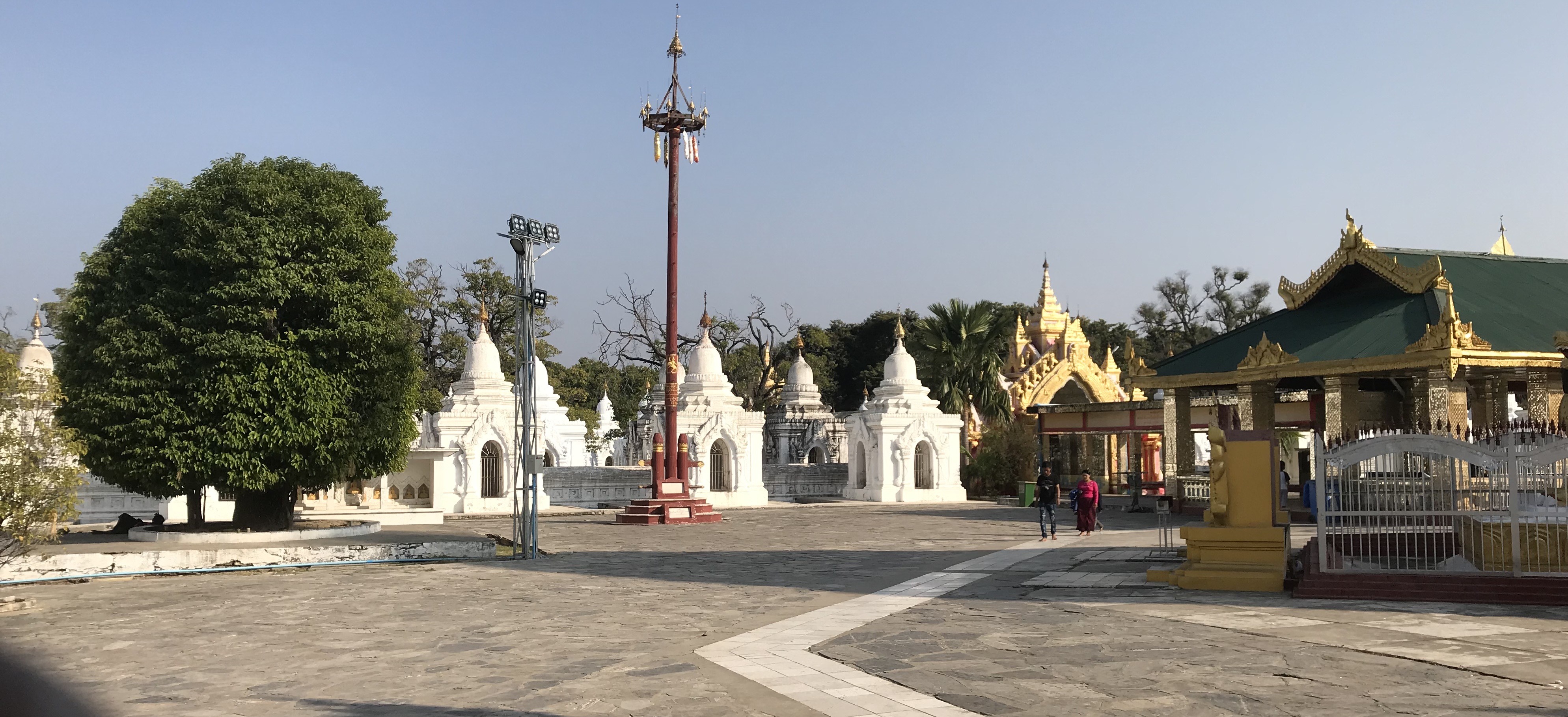
 couple in Warwick had thoughtfully provided us with, as not only the cultural heartland but also the spiritual hub of Buddhism in Myanmar. In and around Mandalay and across the mighty river on the Sagaing Hills are so many beautiful temples and ancient pagodas. They say that almost two thirds of the many thousands of monks in Burma live in and around Mandalay. And of course there are the nuns too, resplendent in their pink robes. We were so lucky, that same
  Burmese couple in Warwick had laid on for us a car and driver and so we spent two and a half days touring the many temples, the old royal palace, and climbing up and down countless steps. Then on our last day, as the dawn was breaking we embarked on a rough old boat to travel that great river, the Irrawaddy, immortalised by Kipling as ‘The road to Mandalay, where the flyin’-fishes play.’ We, of course, were leaving Mandalay, going back down that mighty river that flows the length of Burma to Rangoon and the sea but our destination was Bagan. For ten hours, from sunrise to sunset, we were on that boat, tacking back and forth across this tremendously wide but not very deep river, the captain faithful to a navigable channel. You might have thought it would have been boring after a while but not at all. It was absolutely marvellous.


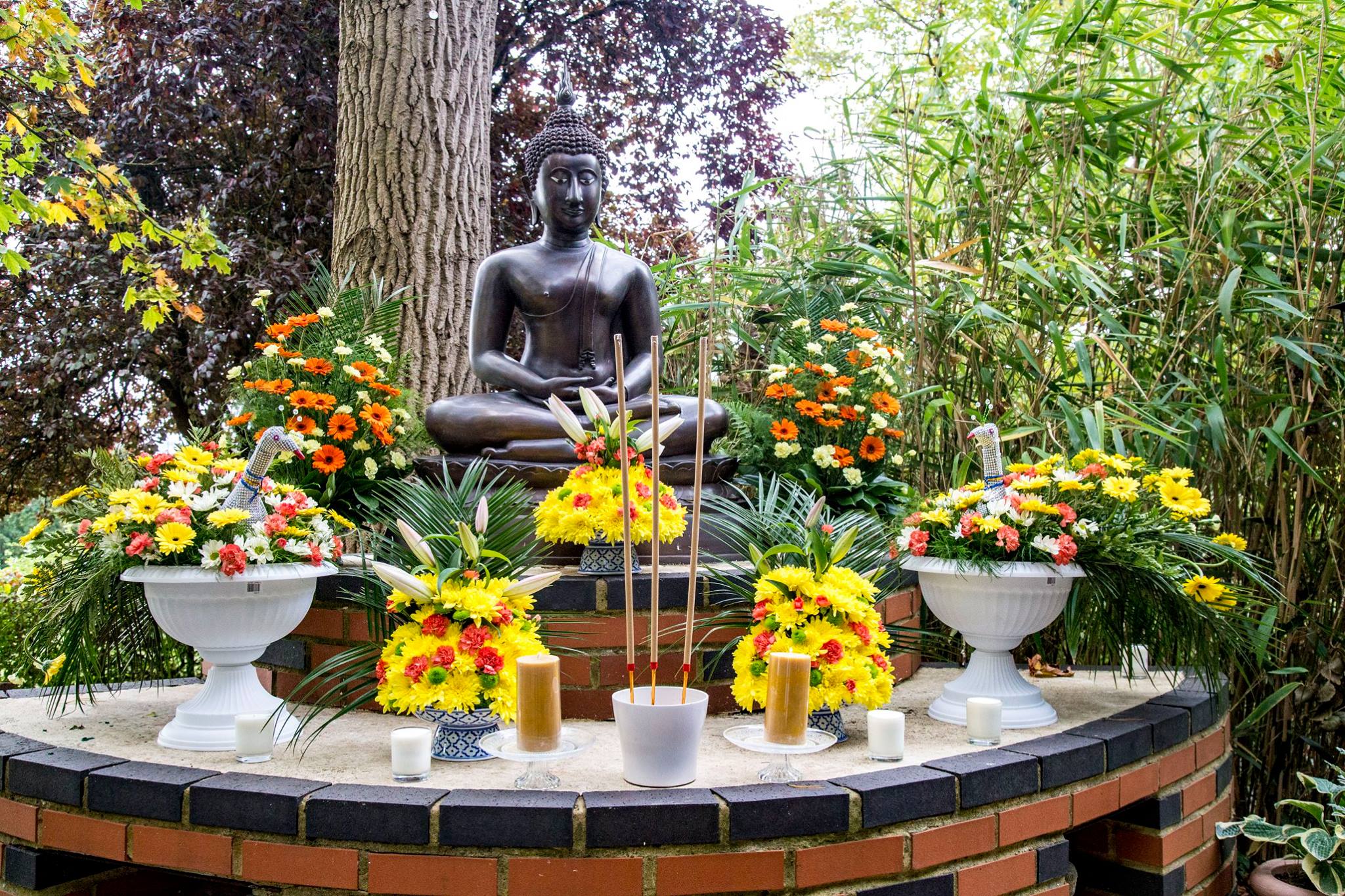
 Avebury who died in February. He had never missed one of these until a couple of years ago when he became too frail to attend. Now this year we paid a special tribute to him and together with members of his family we planted a tree in his memory to one side of the Buddha Image. The inscription on the plaque reads, ‘In Memory of Lord Avebury. A friend to prisoners and of this Buddha Grove.’ Then everyone trooped down to the Dining Hall to queue up together and eat together, prisoners and guests alike. When that was done back we all came to the Buddha Grove to make a triple circumambulation with candles flowers and incense. And so the evening wound to a close with some presentations and a chanted blessing. An extraordinary evening in the life of an English prison!


 19th and the following day was the day of entering the Vassa, the annual Rainy Season retreat, incumbent on all bhikkhus and sāmaneras to observe for three months. As usual our public celebration had to be held on a Sunday when most people are free to attend and the nearest Sunday being the 17th, that was the day we chose. Now the 17th of July just happens to be my birthday, so, I’m afraid that was added to the celebration. Fortunately the weather was good, it didn’t rain, although to begin with it was a bit cloudy but around midday the sun came out and when we gathered outside for the offerings and the sermon that followed it was blazing.


