Author Archives: Luangpor

About Luangpor

Born July 17th, 1944. England. Buddhist monk - ordained samanera December 26th, 1971; ordained bhikkhu May 26th, 1972. Made an OBE in HM The Queen's Birthday Honours 2003. Made a Chao Khun on HM The King of Thailand's Birthday, December 5th, 2004. Abbot of The Forest Hermitage since 1985. Spiritual Director of Angulimala, the Buddhist Prison Chaplaincy. Buddhist Adviser to HM Prison Service & NOMS. Buddhist Chaplain to Warwick University.

The Prison Service Chaplaincy Conference at Warwick University

At the Prison Service Chaplaincy Conference last week I was invited to give a two minute ‘reflection’. I don’t write my speeches nor do I have anyone else write them for me so I can’t report now exactly what I said but I’ll try and give you some idea. You may remember from an earlier entry back in February that the theme of this year’s conference was ‘Trusting the Journey’ and while I was determined not to utter those words I accepted that what I had to say had somehow to chime with that theme. This then is roughly what I said.

There was a time when for me a journey was simply something I had to endure in order to get somewhere and home again. In those far off days my journeys were nearly always about work and my need to be somewhere on time to do what I had to do on some stage or film set somewhere or other. My journeys then had an objective; I had something to do, I had to be somewhere. Later, when I decided to go east and take my Buddhist interests and commitment a stage further I felt that I should make that journey a pilgrimage. At the time I had little idea of what a pilgrimage was but I took off and by various means made my way overland to India where for two months I wandered around the Buddhist holy places. The pressure was off, I had more time to look out of the window and I wasn’t so concerned about when I was going to get there but still I was journeying with the aim of getting somewhere. Then I went to Thailand and made my way up to the North East, to that corner bounded by Laos to the North and Cambodia to the East. There I joined a famous and wonderful teacher called Ajahn Chah and became one of the forest monks. The forest monks include monks who wander, who go on journeys that have a purpose but no objective. They might say that they are going in search of peace or a peaceful place but they are not travelling in order to get anywhere, and certainly not on time, or indeed to be anything. There I began to understand another kind of journey, one that has no objective but is done simply for its own sake.

Yesterday, the last speaker, talking about the latest developments within the Prison Service and the direction and journey it’s now taking, quite candidly admitted that no one really knows where this is going to take us. We could make fun of this or be quite cynical about the Prison Service off again, driven by yet more bright ideas and still not knowing where it’s going to be this time next year! But in truth we never know where we’re going to end up. We can’t possibly tell what’s going to happen or how things are going to turn out. On any journey it’s only this that we can really know about, just the placing of this foot in front of the other, now, at this time, that’s all. And if only we can do that well.

Doing it for the sake of doing it, doing it without wanting to be or gain anything, doing it without really knowing or bothering too much about where it’s going to take you, but doing what has to be done and doing it well, acting skilfully and virtuously, is not only the way to approach chaplaincy, it’s the way to approach life.

There’s talk of evaluating chaplaincy. And who thinks they can do that? The guys in suits who only talk money? But what about the inmates? At this conference there has been nothing from the prisoners but at the last conference we heard from two former prisoners. One of them, Bobby Cummins, I used to visit twenty years ago when he had long hair and was very angry. Remember what he said of you chaplains? ‘You’re diamonds.’

When you love the unloved, when you care for the uncared for and rejected, when you befriend the friendless, you’re diamonds.

Thank you.

Tort Pah Bah & a mini Songkrahn

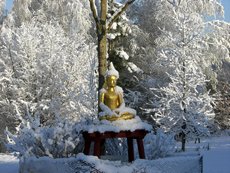
At 3 o’clock in the morning of Sunday, April 6th, I saw that snow had begun to fall. When I looked out a few hours later it had stopped and to my amazement we were under a good six inches of snow. It was very wet, stodgy snow that clung to the branches, weighing them down and making everything utterly beautiful. When the sun came out it was even better. I don’t believe I’ve ever seen snow in April.

That day, Khun Dang, who had turned 60 the day before, was due here to lead the offering of the Tort Pah Bah that she had organised to mark her birthday and fifth cycle. As people began arriving small snowball skirmishes kept breaking out – a snow variation on the water fights that usually characterise Songkrahn. Of course this wasn’t supposed to be a Songkrahn celebration, we’re having that next Sunday but it was close enough to be in people’s minds. I gave the Refuges and Precepts then instead of an alms round outside everyone queued in the Shrine Room to put food in our bowls. After the meal came the offering of the Tort Pah Bah and then I spoke a few words of explanation and I hope, encouragement. Because I knew that some people present wouldn’t be able to make it next week I announced that we would have a mini Songkrahn and again everyone queued, this time to bathe the Buddha Image and then our hands.

It was a great day and made even better by an offering made towards what is still owed to the bank for Bhavana Dhamma (Wood Cottage) of a total of £3,861, made up of £200 from Thailand, £200 collected here, £240 that came in the post and £3,221 that was brought on the day. Fabulous! This week, with Khun Dang’s help as she’s turned 60, we’ve brought the debt down £6,000 to £73,000. Anumodana!

And for Khun Dang, Happy Birthday!

There are some pictures here.

Ten things about Buddhism

For some sort of handbook I’ve just been asked to list ten things about Buddhism that I would want someone who knows nothing about it to know and this is what I’ve come up with.

Buddhism is what we call the original teachings and discipline established by the Buddha as well as the family of separate but related movements that have grown out of those early beginnings and spread in a vast and complex diversity of forms throughout the world.


  1. The Buddha is the One Who Knows or the Enlightened One and is the title assumed by the former Prince following his Enlightenment at the age of 35.

  2. The Buddha lived and taught in Northern Central India about 2,600 years ago.

  3. What the Buddha taught addresses the problem of suffering by explaining its cause, its ending and the way to end it.

  4. That path or middle way is a training in the gradual perfection of virtue, meditation and wisdom.

  5. Buddhist morality is underpinned by the principle of harmlessness and for the laity is expressed through the Five Precepts that enjoin a person to abstain from killing, stealing, sexual misconduct, untruthfulness and taking alcohol and drugs.

  6. Buddhism is a non-theistic religion that has no God, creator or saviour.

  7. Nor is it a belief system, dogma or faith based religion (generally Buddhists would not refer to it as a faith) but instead invites one to come and see and know for oneself.

  8. The Buddha taught that there is no self or soul, rather we and all phenomena arise dependent on causes and conditions and are without any abiding self, soul or substance.

  9. Much is made of merit, the doing of good deeds and the development of generosity, loving-kindness, compassion, non-attachment, truthfulness and patience.

  10. Dependent on the intention, actions have results and it is how one has lived this life that after death conditions rebirth.

A Chinese Group from London.

m_cimg2183.jpg

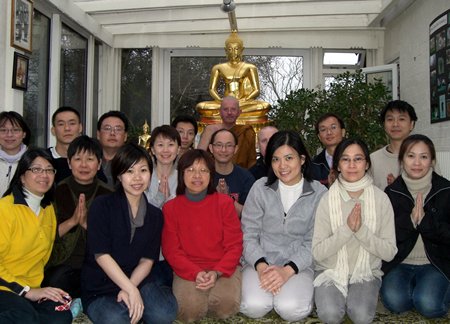
We had a lovely visit today from a charming and generous Chinese group from London. They came with huge pots of tasty and nourishing food as well as their work togs and after the meal they set to painting and cleaning. The rain cut short some of that but then we gathered for a chat and some meditation. I hope they’ll come again soon.

Yesterday with Lord Avebury

m_cimg2159a.jpg

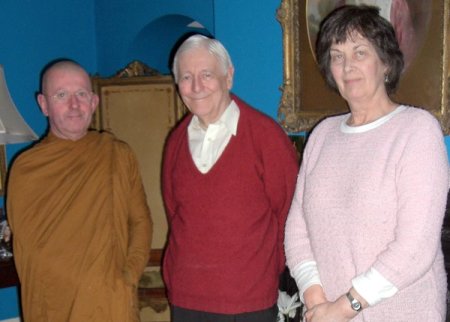
After yesterday’s TBSUK meeting I went over to see my friend Lord Avebury for a chat about a couple of the issues of concern to us. Here I am with Eric and Lindsey (Lord and Lady Avebury) just about to leave for the drive back to Warwickshire, which at that time we confidently expected to be traffic free but how wrong we were!

The Prison Service Chaplaincy Conference

I’ve just added a note to the Angulimala page of this site about the forthcoming Prison Service Chaplaincy Conference in April. Unlike the last two conferences, for this one I am not part of the organising committee. I was probably not much use but I did come up with some good ideas and I’m pleased to see that two of them that weren’t used when I was on the committee have been taken up this time. The first is the venue. I complained strongly that the NEC was not a good place for a conference of this kind and said more than once that somewhere like Warwick University would be much better. This time it’s at Warwick University. The second is that there are to be short presentations about the various principal faiths. I often said that when I attended a couple of the old style Christian Chaplaincy Conferences years ago the most interesting bit had been a sort of forum with chaplains from overseas. Admittedly they were all Christian but of different kinds and it had been very interesting to see and to hear them. So, I had suggested something that would inform delegates about faiths other than their own. That too was never taken up but I have just received an email asking me to prepare and lead a twenty minute session on Buddhism. I’ve also been asked to offer a two minute reflection. The only trouble is that everything including these presentations has somehow to relate to the conference theme of a journey. The title of the conference is Trusting the Journey.

Thinking about this has brought flooding into my mind memories of New York in late 1965. I was an actor then and there for a couple of productions that never quite happened and while flat hunting I bumped into the wife or girlfriend of an actor called Walter McGinn and we became friends. Walter was then on Broadway in a dreadful epic called The Subject was Roses. He got me tickets and took me to meet his co-stars, Chester Morris and Maureen O’Sullivan and then I had to sit through a matinee with his wife. Well, because she was with me I couldn’t leave and so I had to endure the whole wretched thing, including the supremely cringe-making moment when poor Walter had to utter the line that contained the words ‘the subject was roses’ and a frisson went round the auditorium as the New York matrons whispered excitedly to each other that that was the title, that was the title of the play!

If anyone thinks that at the Prison Service Chaplaincy Conference in either of my presentations I’m going to include a line that has ‘trusting the journey’ in it, they’re going to have to think again!

We are back.

All good things come to an end and so did our short stay at Sri Panwa. With so little to do and only the simplest and most basic of decisions to be made our time there passed at nothing like the snail’s pace you might have imagined. It was soon over, our few things were packed and the tuk tuk to take us to the car was at the door. Then it was the ride to the airport, the flight and the drive through Bangkok’s legendary traffic to the kuti at Khun Jung’s for our last night.

Again there were visitors, that evening and the next morning. In the afternoon of our last day we drove over to Wat Sraket to pay our respects to Somdet Keo, then went to get me measured for a new pair of glasses before calling on Sulak Sivaraksa for tea. Sulak is described on the cover flap of his autobiography as a prominent and outspoken Thai Buddhist social critic and activist who throughout his tumultuous life has endured death threats, exile and gruelling legal ordeals – and somehow has thrived. Of course I have known of Sulak for years and people have thought we ought to know each other but we’ve never quite managed to meet until that afternoon. Ken, another Thai former Warwick student, succeeded in arranging it and I’m very grateful to him for that. Sulak was very welcoming, very gracious, fascinating to listen to and generous – he presented me with a stack of books to add to the boxes we had already.

Back at Khun Jung’s we hastened to get ourselves ready and then off we sped to the airport where Thai Airways staff were waiting to speed us through check-in and care for us all the way to Heathrow. Khun Tipvadee, looking younger than ever, was there to see us off. So were Pie and Mark, who was looking forward to getting off back to Korea in a day or two. And Tahn Dhammabhojo, now Chao Khun Chonnyanamuni, with the young monk who hopes to join us in England in the summer, were also there to speed us on our way. Once through Immigration, we were sat in tall futuristic buggies that raced us as near as could be to our Departure Gate, from where we were ushered onto the plane and into comfortable seats to cushion our approach to the culture shock awaiting us at Heathrow.

If you’d like to see some of the photos you can look here.

Phuket

So here we are now on the island of Phuket. And just for the record Phuket is pronounced Poo-ket. Literal transliteration doesn’t always take into account pronunciation.


The sun has not long gone down on our first full day here and I’m sitting at a table in our villa and looking out across the darkness of the sea below to a few lights twinkling on the boats and islands opposite. We came here to Sri Panwa yesterday after a night in Bangkok. Since my last entry we have gone from Bangkok to Ubon, back to Bangkok and now Phuket. But before setting off for Ubon there was Pie’s wedding to go to.


We had nothing to do with the actual ceremonies but on the morning of the 15th, the wedding day, we were invited over to the house to take our meal there. We set off in plenty of time with a map and directions that Pie’s mother had supplied but still somehow our excellent driver had difficulty following them and we got lost. I’m afraid I seldom have much idea where I am in Bangkok so I was no help. Eventually the mystery was unravelled and we drew up in the drive of a large house overflowing with people obviously at a wedding. Ant was there to greet us but he didn’t quite know what to do so Pie was summoned and he led us up to the Shrine Room where food soon appeared and we had our meal. Afterwards we were invited to join the photo call. That was when a rather troubled Mark made his second brief appearance of the day. Poor Mark had eaten somtum the night before and been sick ever since. It’s always fun when you suddenly meet people you’ve known as students and always seen dressed as students in another context with smartly brushed hair and wearing suits!


The 15th proved to be a full and varied day. By the evening we’d left Bangkok, taken a plane to Ubon in the North-east, and were busy settling in to our rather more austere forest accommodation at Wat Pah Nanachat. Although I’d better add that monks there have a pretty comfortable lot compared to what I knew in my younger days.


The next day, the 16th, was the sixteenth anniversary of Ajahn Chah’s death and many of us went over to Wat Pah Pong to eat there. There were a lot of monks, a lot of food and quite a lot of old friends. I sat next to Ajahn Inn who I hadn’t seen for years and who had been one of the chanting acariyas at my ordination. Afterwards the meeting that I was supposed to attend was postponed to the evening and so back I went to Wat Pah Nanachat for a rest. By this time Mark, Ant and Peng, another former Warwick student who’d come for the wedding, and Pie’s cousin, Sandy, were in Ubon. They came out to Wat Pah Nanachat and with them Tan Manapo and I returned to Wat Pah Pong in the afternoon in time for the big circumambulation of the Ajahn Chah Chedi.


The students had the use of a pretty handy vehicle and driver for two more days so on the 17th I took them to Kow Phra Viharn which is a pretty impressive ruin on the Thai Cambodian border. It’s also quite high and a fairly energetic climb. We left the students well behind but they did eventually join Tan Manapo and I at the top. Then on the 18th I took them to Wat Keuan where I lived for about a year in 1973. There were never more than a handful of monks there but it was immaculate in my day. It’s on a peninsula that juts out into a huge man-made lake and we drove, then walked to the furthest tip, to Hua Hin, where we spent a jolly time sitting, scrambling about and posing for photos. That evening, back at Wat Pah Nanachat we said goodbye to the two girls, Peng and Sandy, who were returning to Bangkok and so the day after, with only Ant and Mark left, Peter came over from Amper Deht to take the four of us to see my old friend and mentor Ajahn Dang and then to Peter and Tipawan’s splendid home for afternoon tea served in best, beautiful china. The next day we’d lost Ant who’d gone off to see a family he knew and so with only Mark left of our student party we went over to Wat Pah Pong for my guided tour. We were taken there by the two judges, Katekaew and her husband. Katekaew was at Warwick for a year nine years ago. And accompanying us was my wonderful attendant for my stay at Wat Pah Nanachat this year, an Indonesian novice called Visilo. We finished up our visit to all the important sites, the Ajahn Chah Chedi, Ajahn Chah’s kuti, his hospital kuti where he died and the place where he had first camped, by picking up four boxes of books to bring back. Two subsequently went with Mark who had to race off to the airport to meet up with Ant to join him on the plane to Bangkok and two were later added to by a third and all three boxes are now waiting for us in Bangkok. Later on that day at Wat Pah Nanachat I took a Question and Answer session with the monks and novices that seemed to go down quite well. The day after was Monday, the 21st, and we didn’t go anywhere.


The 22nd was a Wan Phra, a Full Moon Observance Day, and we had to hear Patimokkha, the basic Rule for Bhikkhus. At my request that was done after the meal in the morning so that Tan Manapo and I could be there for it before catching our plane in the afternoon. After Patimokkha I was invited to address the Sangha and I enlarged on some of the points I’d made in the morning Ovadas I’d already given. I spoke of the importance of a caring community. What we are committed to as monks can be difficult and demanding and it’s important that we can care for and help each other through any hard times. I have known communities where the emphasis has been on surrendering to the community but it seemed without any corresponding duty of care by the community for its members. It’s easy both for individuals and the community itself to become harsh and judgemental and that’s not helpful. As Ajahn Chah has pointed out, metta or loving-kindness is a vital ingredient in the way of life and training that we have adopted. I also reminded them to not take things for granted and to appreciate the wonderful facilities and support they have and to be worthy of it. I also pointed out that while some things about our life can be inconvenient, this discipline is forever reminding us of our kilesas (defilements) and keeping us aware of them. During my Question and Answer session with them earlier I had described how in the past instead of collecting our food, as is done now, from a buffet and being able to pick and choose, we used to have to sit and watch the food being dished into our bowls by the monks delegated to go down the line giving it out. We could refuse some things if we were quick enough but it wasn’t good form to do so and we were taught to watch our minds, especially when something delicious was immediately swamped by some curry we didn’t like or we didn’t get as much of something as we wanted. At the end of the day, that food is given in faith, it does the job and we’re jolly lucky to have anything at all. And so the old monk rambled on.


Back in Bangkok that evening a few people came to see me, mostly students or ex students who used to come to the Forest Hermitage when they were in the UK. And then the next day, our Nok Air flight having been cancelled, we stepped aboard a One,Two,Go plane for Phuket and here we are.


I don’t want to make you jealous but if you want to see where we are go to www.sripanwa.com.


For another account of Pie and Nun’s wedding and some of our adventures have a look at Ant’s blog.