I’m not usually exactly what you would call a great traveller, that is unless you take into account the mileage I clock up every year visiting prisons and away on Buddhist related prison business. But last year was different. As usual I was away in January for the Ajahn Chah memorial event, and that was followed by a week in Burma and then another week back in Thailand. In May I was invited as a speaker to the UN Day of Vesak in Vietnam, and that was followed by a short conference on Mindfulness and another Vesak celebration at the UN building in Bangkok. In June every year at Wat Pah Pong there is what is known as the June Meeting, a huge Sangha gathering of monks from the various Wat Pah Pong branches mostly in Thailand but also from all over the world, and I went to that too. Then later in the year I was invited to an event at a new forest temple in Norway and in December I went to Slovenia to conduct the first ever novice ordination of a Slovenian in Slovenia.
Now this year, I’ve once again been on my annual trip to Thailand and Burma. The main reason for this is the Ajahn Chah Memorial Day on the anniversary of his death, January 16th, twenty-eight years ago.
I’ve written about the Ajahn Chah memorial event before and every year it follows much the same format but with the crowds never diminishing, but if anything, increasing, although as time passes and we all age it’s inevitable that practically every year there are one or two familiar faces missing from the front line of elder monks. It remains an extraordinary tribute to a monk who rose from very humble origins to become a teacher and inspiration to millions across the globe simply by being true to his monastic discipline, practising what the Buddha taught and talking about it in ways that spoke directly to the hearts and minds and experience of those who heard or have read what he said. As every year, in the afternoon there was a procession of many hundreds of monks followed by thousands of lay followers that from the main meeting hall then wound its way all the way out to and around the Ajahn Chah Chedi where his relics are kept, until with the entrances and steps packed with monks and the whole area gridlocked and covered in devotees the Acariya Puja was read out and we each made our offering of flowers, candles and incense.
Then two days later, I was off to Bangkok and from there to Mandalay. This too is becoming a habit. Our little party numbered five in all: me, Ajahn Manapo and three lay followers. From the same hotel as every year we went out each day to various beautiful and inspiring places.
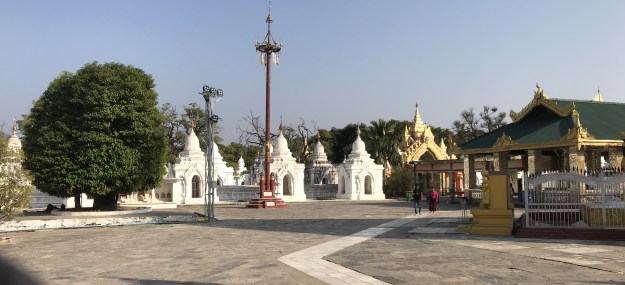
We went twice to U Bein’s Bridge, an extraordinary affair, almost three quarters of a mile long, made of teak and spanning a huge lake that at this time of the year is partly dried up and cultivated, some of it already planted and some still being tilled by elegant high stepping white oxen. On our second day we were treated to a fabulous day out by a young lady who used to be at Warwick Uni and apart from when a certain football team was playing was a regular every week at Warwick Uni Buddhist Society and was its President for one year. She took us into the hills north of Mandalay to a magnificent cave that following a stream wound its way deep into the hillside. A cave made even more magnificent by the dozens, if not hundreds, of Buddha images placed here and there throughout its length. In some places these were grouped with other images to form tableaux illustrating events in the Buddha’s life. So, for example, there is the Buddha subduing Angulimala with, in the background, Angulimala’s mother who he was about to kill when he spotted the Buddha. Then the same evening we paid a visit to the Jade Pagoda, a favourite now since we were introduced to it last year, a pagoda covered entirely with jade of various colours and types, the gift of one man. In the evening when all lit up and when most of the people there are Burmese it’s at its best. The almost casual but deeply rooted devotion of people in Burma at these sacred places is indescribable. There’s no forced or false piety, instead a moving, deep and abiding trust and affection that is almost tangible. The next morning, once again, we made our boat trip to Bagan down the mighty Irrawaddy. This colossal river absolutely captivates me. I’d love to spend more time exploring it. This year we were on the same boat as last year and again looked after by a young and very helpful Burmese woman keen to improve her English. A feature of the trip was a stop at a village where the local industry was the production of rather crude but practical earthenware pots. Last year when I was there, I wandered away from the main party and stood for a few minutes in a dusty pathway. Just then two women turned the corner bearing impressive loads on their heads. They had to pass me but one of them was wearing sandals. To her and the culture she comes from it would have been the height of disrespect to have walked past me with her sandals on, so she performed the impressive feat of bending and removing them without dislodging the load from her head before, still politely lowering herself, she passed by. That was the most unforgettable gesture of respect I’ve ever seen and would be a real lesson for modern Britain where the principle of respect seems to have had its day.
Yangon followed Bagan and here, as it is every year, it was the great Shwedagon that was the highlight of our visit. We deliberately stay in a certain hotel because of the perfect view we have of it, especially at night. This is the mighty Pagoda that dominates Yangon and has to be one of the most remarkable and holy places on earth. I well remember in 1987 a Burmese lady passionately insisting I must go there and how sceptical I was. But when I went, I was enchanted, and all these years and many visits later I remain enchanted. The effect, the atmosphere is indescribable.
By the time I flew back to Thailand, and a few days rest by the sea before my return flight to Heathrow, the coronavirus was beginning to hit the headlines. At Suwanabhumi Airport masks and concern were already visible. Nothing at Heathrow. But now the lockdown and a new and different world.
A PDF of my News & Musings as published is available here.


 The obvious inspiration for this impressive memorial ‘garden’ have been the huge stone pillars and stone railings erected by the Emperor Ashoka two thousand years ago in India to mark places of significance in the life of the Buddha. Those polished sandstone pillars, most of which have been broken, although one still stands at Vesali, were about fifteen metres tall. For this Ajahn Chah pillar, I was told it took three attempts by the quarry to extract an unbroken piece of stone large enough and then three days to transport it on the only vehicle in Thailand large enough for the job. Once erected and in position stone masons have spent the last four years working on it. Various monks have helped with the surrounding area and one, Luang Por Anek, has sculpted and crafted some of the stone work, particularly the two slabs you can see in the picture on either side of where I and the group are sitting. I think it’s a wonderful and hugely tasteful memorial to Ajahn Chah and like those Ashoka pillars I’m sure it will last for hundreds of years. And perhaps just like those Ashoka pillars, at some time in the distant future it will provide for future generations a clue that will lead them to learn of a remarkable man who rose from humble beginnings to live the Buddha’s message and in his own way teach and transform the lives of thousands all over the world. That’s what the Buddha’s teachings – and the example of people like Ajahn Chah – do, they change people utterly and for the better.
 sponsored and run by followers of The Forest Hermitage before a drive out to see an old friend and mentor who is in indifferent health but still manages to go on a long alms round every day in his electric wheelchair. I should have mentioned that to feed the thousands of devotees and hundreds of monks gathered at Wat Pah Pong, dozens, perhaps hundreds of food stalls dispensing free food were operating at all hours of the day and night.


 couple in Warwick had thoughtfully provided us with, as not only the cultural heartland but also the spiritual hub of Buddhism in Myanmar. In and around Mandalay and across the mighty river on the Sagaing Hills are so many beautiful temples and ancient pagodas. They say that almost two thirds of the many thousands of monks in Burma live in and around Mandalay. And of course there are the nuns too, resplendent in their pink robes. We were so lucky, that same
  Burmese couple in Warwick had laid on for us a car and driver and so we spent two and a half days touring the many temples, the old royal palace, and climbing up and down countless steps. Then on our last day, as the dawn was breaking we embarked on a rough old boat to travel that great river, the Irrawaddy, immortalised by Kipling as ‘The road to Mandalay, where the flyin’-fishes play.’ We, of course, were leaving Mandalay, going back down that mighty river that flows the length of Burma to Rangoon and the sea but our destination was Bagan. For ten hours, from sunrise to sunset, we were on that boat, tacking back and forth across this tremendously wide but not very deep river, the captain faithful to a navigable channel. You might have thought it would have been boring after a while but not at all. It was absolutely marvellous.


 News & Musings