

These newsletters have been written principally for Buddhist men and women in prison but I offer them here in case they might be of interest to others.
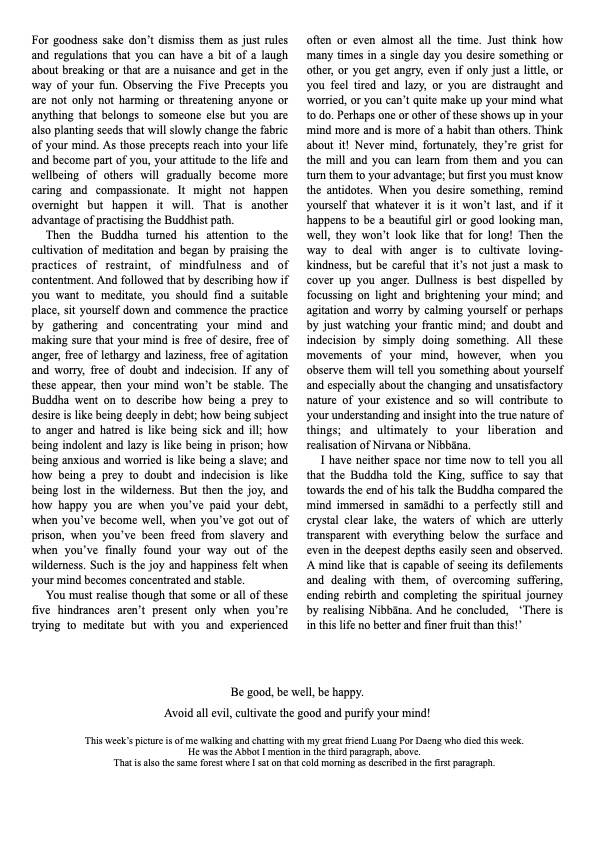
Normally, today, January 16th, I would be in Thailand at Wat Pah Pong for the annual remembrance of the late, great Ajahn Chah, the teacher under whose guidance I spent my formative years as a monk. After a long illness, for ten years of which he was practically paralysed and physically helpless, Ajahn Chah died on January 16th, 1992. He was seventy-three. A year later on the first anniversary of his death he was given a state funeral in the presence of the King and the Queen, the Prime Minister and all sorts of well-known and important people, as well as hundreds of monks and thousands of not so well-known but still important devotees and followers, who all crowded into Wat Pah Pong to pay their respects to this remarkable man who for so many had been teacher and friend, father and guide. Since then, every year, in the days leading up to January 16th, monks and devotees have gathered at Wat Pah Pong, many camping out in the forest, to practise meditation and listen to the Dhamma. On the 16th itself, in the afternoon, a procession headed by the senior monks and joined by hundreds of others, and thousands of lay devotees, leaves the principal meeting hall and makes its way down the main drive and out along the old perimeter path to the Ajahn Chah Chedi, which houses his relics. It’s impossible to properly circumambulate the stupa as there are so many and before we’re two-thirds round, the entire area is gridlocked. At that point the Acariya Puja in praise of the Ajahn or Teacher is recited. It is a stunning occasion and years ago when these annual events began I vowed never to miss one. And so, ever since I’ve been there year after year, apart from only one when I had the flu and couldn’t travel. This year not only can I not travel but in any case, because of Covid, for the first time, the days leading up to the 16th have been more or less cancelled, and the procession to the chedi significantly reduced. Such a shame!
In 1971, when I arrived in Thailand, Ajahn Chah was not yet that famous but I had heard of him through a monk I knew in London and then soon after I had become a novice, in Bangkok I ran into an old friend of mine who was already in robes who told me that if I wanted to become a real monk there was only one place to go, Wat Pah Pong, Ajahn Chah’s monastery in Ubon, in the North East corner of Thailand. Well, when someone says something like that, what can you do? I went to Wat Pah Pong.
Luckily for me, the monk I’d known in London who had recommended Ajahn Chah, had just showed up in Bangkok and asked me to take notes for him while he made a study of a northeastern village, while there he promised to take me to Wat Pah Pong and introduce me to Ajahn Chah. So New Year’s Day 1972 found us on the train at the start of that expedition. When I got to meet Ajahn Chah he agreed to take me on but first I had to return to Bangkok to tie up a few loose ends and obtain permission from my upajjhaya or preceptor. So it was early February before I was back and settling into a modest hut and the simple routine of Wat Pah Pong. But then suddenly, that was disrupted when most of us were shipped off to one of Wat Pah Pong’s more spectacular branches that took in most of small mountain and gloried in the romantic name of Tum Saeng Pet, the Cave of Diamond Light. The purpose of our move was to prepare for the offering of a newly built meeting hall on the very top of the mountain that had been initiated by a local titled lady, an ardent supporter of Ajahn Chah, who was also apparently the widow of Ubon’s premier gangster! The offering took place on the full moon of Magha Puja, over three nights of chanting and long Dhamma talks, not a word of which I understood. But I loved the unpredictable tones and rhythms of the local Isahn language and the inspirational sight of Ajahn Chah sitting there surrounded by row after row of silent, seated monks; rather like, I thought, it must have been in those holy places in India that I had recently visited, when the Buddha was present surrounded by a huge gathering of monks.
I stayed on at Tum Saeng Pet as the hot season kicked in and alms food became scarcer and scarcer and I struggled to recover from smashing a toe of my barefoot into a hidden root one morning hurrying to a village for alms. Then one day in early May, Ajahn Chah turned up to collect me and take me back to Wat Pah Pong for ordination as a bhikkhu, provided I promised to stay and live under his tutelage for the next five years, which at the age of 27 seemed a very long time. And so my life in various remote forest retreats within the Ajahn Chah tradition gathered momentum and that’s where I spent the next few years of my life.
It wasn’t until 1977 when Ajahn Chah was invited to London, to the Hampstead Buddhist Vihara, the very place where I had first discovered Buddhism, and I accompanied him, that I returned to England. It was supposed to be a two month visit but Ajahn Chah soon decided otherwise and suddenly I found myself not destined to return to Thailand but staying on there indefinitely. But when we’d arrived the two properties on Haverstock Hill owned by the English Sangha Trust, 129, the house of bedsits that provided an income, and 131, the Vihara itself, had just been sold, at least the sale had been agreed but not yet completed. One evening sitting with Ajahn Chah he asked me why they had sold the place, remarking how suitably peaceful it was. I told him that the sale hadn’t been completed and furthermore could be stopped and he could stop it. At my suggestion the Chairman of the trust was called and Ajahn Chah asked him to stop the sale and he did, so then we had a place to stay. Later on when the third house of the block of three came up for sale, Ajahn Chah wanted it bought and we even viewed it but the trust couldn’t manage it.
Since before I left England in September 1977, I had known that the Hampstead Temple was sometimes consulted by various prisons, so I wasn’t especially surprised when letters came from Parkhurst and Pentonville and a phone call from Holloway, all asking for someone to visit their Buddhist prisoners. One day, I was alone with Ajahn Chah on a train, somewhere near Guildford when I tentatively asked him what he thought about my teaching Buddhism in the prisons and as far as I remember, he answered with just one word, “Go!” And that was how my prison involvement began.
Life with Ajahn Chah and in the several small branch monasteries where I stayed in those early years wasn’t as easy as you might think. The main events of each day were the 3a.m. bell; the early morning hike at around dawn to one or more villages of varying distance where perhaps twenty of thirty fairly poor people would line up to make merit with a pinch of rice for each of our bowls; the one meal of the day, taken in silence and eaten communally and from our bowls; water hauling in the afternoon from the wells and carried on poles between two of us in something like ten gallon cans to the bowl washing places and wherever water was needed; and usually, but not always, because Ajahn Chah liked to surprise us by varying things from time to time, morning and evening group meditation and chanting. And that was it! We didn’t have much of anything and entertainment was confined to an occasional chat over a cup of tea. Patient endurance was frequently prescribed and often needed to deal with aching knees after long hours sitting on a hard floor through meditation and long sermons. But if any of that sounds a bit bleak it was still an extraordinary opportunity to live simply and practise what the Buddha taught. Part of Ajahn Chah’s genius was the inspirational way he guided us in the use of the monastic discipline and of the daily routine to watch our minds and know ourselves and to see the Dhamma, the Buddha’s message in practically all that we might experience. I don’t believe anything but the Buddha’s Dhamma interested him in the slightest. He truly lived the Dhamma and gave himself totally to his monks and to the constant stream of visitors who came to him from far and wide for comfort and advice. Constant themes in his teaching were the uncertainty of life, the importance of seeing through conventions and the need to let go. And it was all delivered with great good humour and loving-kindness, and without mucking about.
He would teach too through simple everyday occurrences. One morning as we arrived back from the alms round he took me with him on a stroll round the monastery. When we came across a long, ungainly branch that had fallen across the path he motioned me to get hold of one end while took the other and as we lifted it, asked me, “Is it heavy?” Then as we launched it into the undergrowth and let it go, “Now is it heavy?”
I suppose what has inspired me most about Ajahn Chah has been his generosity, his commitment and his ability to offer a truly living Dhamma. As people related their troubles and frustrations to him, he would listen sympathetically, with a wry sense of humour, and then holding up a mirror to their own actions and attitudes, teach them Dhamma, relating it immediately to what they were experiencing.
I go back year after year to remember him, to remind myself of my time there; and if only through my continued presence and support, to do what little I can to keep alive his influence and expression of the Buddha’s unique message.
(This has been adapted from something I write every week, first as a broadcast for National Prison Radio, and then is expanded as a letter that I call News and Musings, which is sent to all those in the prisons who are Buddhist.)
When the lockdown began I was asked to give a weekly talk for National Prison Radio. I decided to adapt the text of my talk for a weekly newsletter for Buddhist prisoners. This was my talk on April 29th with a pdf of it in the April 29th newsletter here.
Next week, here and in some Buddhist countries on Wednesday, and in others on Thursday, most of the Buddhist world will be celebrating an occasion known variously as Vesak, Visakha Puja, Buddha Jayanti, Buddha Purnima, Kason, Saka dawa, and Buddha Day. It’s a massive celebration, a contemplation and outpouring of love and devotion for the Buddha and it focusses in particular on his Birth, his Enlightenment and his Parinibbana or final Passing.
This week I shall focus on the birth.
Although it’s common to speak of the birth of the Buddha he didn’t become the Buddha until he was thirty-five when he achieved his Full and Perfect Enlightenment. Prior to that we refer to him as the Bodhisatta, that is a ‘wisdom being’ intent on becoming a Buddha. A Bodhisatta over successive births, develops and matures certain qualities known as the Parami or Perfections. So, although, by the time of his birth he had established a firm foundation from which to make that final bid for Enlightenment, nevertheless, he was born a human being, just like us, with a man’s normal desires and delusions.
He was born in the foothills of the Himalayas, into the ruling family of a minor state that straddled the modern borderlands of India and Nepal. The Queen, his mother, had in fact been on her way to give birth in her family home and had stopped to rest in the Lumbini garden when the child was born. Later, at the palace, an aged ascetic of high spiritual attainment named Asita came to see the child. On being presented to him the old man first smiled and then wept. When the King demanded to know what this meant, Asita said that he’d smiled when he recognised that this child would be a Buddha but then wept when he realised that he, Asita, would not live to see it. At the young prince’s traditional naming ceremony he was called Siddhattha, which means ‘wish fulfilled’. Then eight learned brahmins were asked to predict his future. Seven of them said that should he take to the religious life he would become a Buddha but if he remained in the world then he would become a powerful monarch. The eighth and youngest confidently predicted he would achieve Enlightenment and be a Buddha.
The prospect of his son becoming a universal monarch fanned the flames of ambition in the King’s heart and so he determined to do all in his power to keep the boy’s mind well away from religion and spiritual matters. He was given all he desired and when he was sixteen married to a ravishingly beautiful princess.
The exact year of his birth is uncertain, although like the Enlightenment and his Passing, his Birth is supposed to have occurred on a Full Moon of the ancient Indian lunar month of Visakha, a month that usually corresponds roughly to our month of May. Which is why this festival always falls at about this time of the year. Traditionally, the year of his birth is believed to have been 623 BCE. Of course, a few modern scholars have disputed that but whenever it was, it was certainly a very long time ago.
Following the invasions that put paid to Buddhism in India, the location of the birthplace, with practically all of India’s Buddhist past was gradually lost and forgotten beneath the dust of centuries. But then throughout the nineteenth century, thanks to a few, mostly British, amateur archaeologists India’s Buddhist past was gradually rediscovered. Their researches were aided by the inscribed and polished stone pillars that Ashoka, India’s greatest Emperor and a Buddhist, had raised to mark the more prominent places of the Buddha’s life and ministry; and they were helped too by the written records of two Chinese pilgrims, one in the 5th Century and another in the 7th that gave detailed descriptions of their visits to the holy places. In 1896, just across the border and a few miles inside Nepal the broken pillar that marked the birthplace was finally unearthed. In 1997 Lumbini was designated a UNESCO World Heritage Site. Then in 2013 the remains of a shrine which had apparently surrounded a tree was unearthed at the Buddha’s birthplace and carbon dated from the 6th Century BCE. Now Queen Maha Maya, the Buddha’s mother had given birth standing beneath, and grasping the branch of, a sal tree. We can only speculate but it seems likely that it was that tree around which this ancient and newly discovered shrine had been built.
Nowadays, there is a nearby town boasting well-appointed western style hotels and around the birthplace itself are many temples representing various Buddhist countries and styles of Buddhism; and daily come hundreds, if not thousands, of pilgrims to pay their respects at the foot of that ancient pillar.
It was so different when I first went there in 1971, I remember for the last twenty miles or so of my journey sitting in the back of a cycle rickshaw and crossing into Nepal at a border post that was marked by little more than a huge bamboo levelled across the road and raised when my passport had been duly inspected and stamped. When I arrived at the then only temple at Lumbini it was almost dark and I remember the resident monk saying that that evening he was going to light the lamp in the top of the temple because the Home Minister of Nepal would shortly be arriving – by elephant! Sure enough, as the evening drew in we could hear and feel the thud of those mighty footsteps as they approached.
Now what should you do on Buddha Day? Well, your options are limited but it’s still a very special day so dedicate the day and begin by sitting in front of your shrine with its image or picture of the Buddha. Never mind if you have no incense to offer or it remains unlit. Go over the precepts and see how you might work better with them in future. Read some relevant passages of scripture and remember to be especially kind and tolerant and in your meditation to recollect the Buddha and cultivate Loving-Kindness.
May you all be well and happy and at peace.
When the lockdown began I was asked to give a weekly talk for National Prison Radio. I decided to adapt the text of my talk for a weekly newsletter for Buddhist prisoners. This was my talk on April 22nd with a pdf of it in the April 22nd newsletter here.
By the summer of 1971, my obsession with Buddhism had reached a point where I decided to put my career on hold and go East. I had no clear plan but felt that my journey should be done in the spirit of pilgrimage. I sold my little house; told my agent I would be away for a bit and on September 1st set off. A month later I was in Afghanistan. I can’t remember now whether I knew of the of the giant Buddhas of Bamiyan before I reached Kabul or not. I rather think I’d heard of them, then the largest Buddha Images in the world, the two of them hewn out of the cliff face, the larger standing 180 feet and the other 125, but it was when I was in Kabul that I first seriously thought of visiting them. I don’t now know when or why, all I know is that I was soon going back and forth to the tourist office in a state of suspended indecision desperate for reliable information. What I discovered was, that, yes, it was possible to get to the Bamiyan Valley and it wasn’t really very far, certainly not as the crow flies, but the terrain was very difficult and the road awful, which meant a very long and uncomfortable bus ride that took from the early hours of the morning almost all day. The alternative was to fly, but the planes didn’t appear to be too reliable and they only flew twice a week, which meant being stuck there for at least three days – and that depended on the next flight actually happening and then getting a seat on it back. Added to all of this, no one seemed able to tell me if there was anywhere there where I could stay. None of the photos of the Buddhas showed any sign of there being a village, let alone some form of hotel or guest house. So back and forth I went, questioning and yet again questioning the lady in the tourist board and being none the wiser. The bus, I was told, was cheaper and went from somewhere in downtown Kabul at about three or four in the morning. I decided to check it out and one afternoon wandered down to where the bus was supposed to leave from. Well! What a place! There were all these murderous looking, moustachioed, bandit like chaps strolling about with bandoliers of bullets strung across their chests and cutlasses stuck in their belts – and little me was supposed to come down there at three in the morning by myself! I mean, I’m not very big and the idea of risking going down there in the early hours of the morning seemed absolute madness. Later I met someone else keen to see the Buddhas and we discussed going together – but then I was offered a ride all the way to New Delhi. And fool that I was, I thought, ‘I’ll go to see the Buddhas next time.’ And I took the lift.
Well, there never was a next time. And now there never will be. In 2001 the mighty Buddhas of Bamiyan that had stood there for 1,400 years, in a feat of supreme vandalism were blown up and destroyed. Their destruction hit the headlines, never mind that hundreds of people there and in other parts of Afghanistan were existing in almost unendurable conditions, cold and starving or that hundreds had been killed in desperate struggles for power, for a little while the world stood still, mesmerised by the image of those unique and ancient images being blown to smithereens.
Since then occasionally someone has kindly said to me how sorry they were that it happened, expecting, or believing, I suppose, that I was upset and mourning their loss.
Well, I wasn’t. Instead, I asked myself what there was for me to learn from this. What had it to teach me?
First of all, I’d made a mistake. I’d had the chance to go to Bamiyan and I hadn’t taken it. Basically, don’t put off to tomorrow what can be done today. Remember, that in a sense tomorrow never comes. Or at least, if it does, it’s never a hundred per cent quite what you expected. Really and truly we can’t be certain of the next minute, never mind the next day. I’d had my chance and I should have taken it. The risks were slight and had I flown there and had to stay three days; I would have managed. So, don’t pass up your opportunities, you may never get the chance again.
Next, don’t things change? Those Buddhas probably didn’t look anything like they had when they were first completed. It’s a pretty exacting climate in which they’d stood for 1,400 years and they’d obviously aged and deteriorated. Isn’t that what happens to most things, us included? And don’t we and just about everything else eventually die? Isn’t Impermanence what the Buddha taught as the first of the Three characteristics of all conditioned things?
I imagine that all those hundreds of years ago when these Buddhas were created, that was a thriving Buddhist community. As well as the Buddhas, the cliffs are honeycombed with caves in which monks lived and there must have been a sizeable and prosperous Buddhist population to support them and to make and care for these huge images. I wonder if it ever occurred to them that in just a few hundred years Buddhism there would be supplanted by another religion and disappear from that part of the world entirely. There’s a lesson for us, as generation by generation people, especially young people, take for granted the democracy, the freedoms, the rights that previous generations fought so hard for and were prepared to defend with their lives. Don’t be complacent. Don’t take those freedoms and rights for granted, they might just disappear if you don’t watch out.
Of course, it’s perfectly natural to be upset and to be angry when things you cherish are threatened, insulted, damaged or destroyed. But is that right, is it any use? Doesn’t it defile and spoil your mind and your life bringing no peace and happiness. Don’t you harm yourself more? So, what did the Buddha have to say? Over and over again, whatever the circumstances, the Buddha counselled against holding onto anger and resentment. Don’t feed it, don’t go on and on thinking about whatever it was, there’s no need to be offended, don’t be upset, let it go, let go.
My absolute best wishes to you all.
May you all be well and happy, may you all be free from suffering, may you all be at peace.
Goodbye.
When the lockdown began I was asked to give a weekly talk for National Prison Radio. I decided to adapt the text of my talk for a weekly newsletter for Buddhist prisoners. This was my talk on April 15th with a pdf of it in the April 15th newsletter here.
It’s eerily quiet! This week we should have been celebrating the South East Asian and Sri Lankan New Year, when even small forest temples like this would normally be seeing an increase in those coming to bring food, to make offerings and to pay respects; not to speak of the crowds that would normally flock to temples in Buddhist countries like Thailand, Burma, Laos, Cambodia and Sri Lanka with the streets there full of people in celebratory mood showering each other with water.
Songkran, the sun moving into Aries and thus signalling a New Year, falls from April 13th to the 15th. However, in England we usually choose a Sunday, either just before or just after April 13th, for our main celebration. Of course, during the actual days of Songkran a few people do still manage to come to the temple but it’s a practical expedient to have the main event on a Sunday.
At the Forest Hermitage, which is a Thai style forest temple with Burmese connections, on the chosen day, from about ten to ten-thirty in the morning, a crowd gradually gathers of people from all over the country. Most are Thai with a smattering from other Buddhist countries and there are friends and husbands who are English with children of course who have been born and brought up here. Most of the Thais will be in traditional costume. Since good Buddhists wouldn’t dream of coming to a temple without things to offer, they bring with them food and all sorts of supplies they think we might need or find useful. The cooked food that everyone will enjoy shortly before twelve is set out on warmers in the marquee and the rest of the offerings are assembled in our main Shrine Room where everyone gathers. The day proper begins by chanting and bowing to the Buddha, the Dhamma and the Sangha. The congregation next chants the request to receive the Three Refuges and the Five Precepts. These are given by my reciting them one by one and the people repeating them after me. Just to remind you, the Three Refuges mean going for refuge to the Buddha, to the Dhamma and to the Sangha; and the Five Precepts are the undertakings to abstain from killing, to abstain from taking that which is not given, to abstain from sexual misconduct, to abstain from false speech and to abstain from alcohol and drugs. For more than two thousand five hundred years people have been declaring their commitment to the Triple Gem by the Going for Refuge and undertaking to observe these precepts. This is how one formally becomes a Buddhist and nowadays at practically all special occasions it’s usual for people to retake and reaffirm their commitment. This is how our festivals usually begin. Next comes the alms-round, an attempt to replicate what happens every morning in these Buddhist countries. The people line up to put rice in our bowls as we monks walk slowly along the line. At the end of it various vegetarian curries and dishes are offered to add to the rice and then we eat, and everyone eats. After the meal and when the clearing up has been done, we all assemble again in the Shrine Room and the things that have been brought and the money that’s been collected are all formally offered. Then as part of the blessing for the food and all that’s been given, I give a short talk. The Buddha made the point that while we monks are dependent on the lay community for all material needs and support, the laity should expect from us spiritual inspiration, encouragement and instruction.
My talk will be on the meaning of Songkran. How it’s a time when, traditionally, families come together and respect is given to the elders of the family, to parents, grandparents and to the elderly in general. This is the meaning of Songkran, respect. It’s a time to remember our debt to those who have gone before, to those who have brought us up and cared for us, who have taught us and whose efforts in the past have laid the foundations for the privileges and prosperity and freedoms that we have inherited and should never take for granted. Showing respect too makes for humility and challenges our pride and arrogance. We’re encouraged to bow often, when we enter the Shrine Room, when we leave, and as well as bowing to our senior monks, to place our hands palm to palm when speaking to them. I remind them that the Buddha said that to respect those worthy of respect is a great blessing. And I tell them that Songkran is also a time to spread good wishes for the coming year and the chance too to pick oneself up and to make a fresh start.
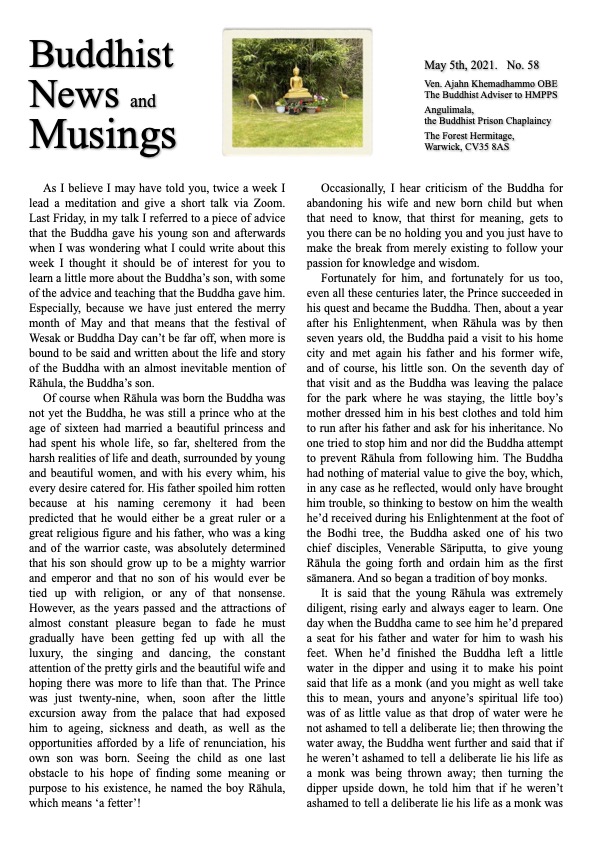
By the time my talk’s over and I’ve chanted the blessing, things will have been set up outside for the bathing ceremony. This is when as a token of respect first the Buddha Image will be bathed and then the hands of the monks, then the elderly will be sprinkled and after that everyone’s fair game, that’s when the fun begins. So, at the large Buddha in the garden I begin by splashing it with water. Then when I’ve taken my seat, the next monk does the same but before he sits, he pours water over my hands. Then the next will do the same and bathe the second monk’s hands as well before sitting. And so it goes on, then the lay people begin, bathing first the Buddha and then each of us, coming down the line, one by one, pouring water over our hands. This is all done with great care, reverently and mindfully. Finally, they turn to each other, sprinkling the elderly and seniors amongst them first and then whoever happens to be nearest, taking pleasure in being together and wishing each other a Happy New Year. But then it’s not long before the fun begins and by the end of the afternoon quite a few are queuing up to change into dry clothes. It’s all very good natured.
That’s how it has been but this year as we know has been different and it remains here still eerily quiet. However, after a dull, cold winter, now with the sun shining, the blossom coming out, the bluebells in flower we can feel refreshed and go forward with a spring in our step and with hope.
May you all be well and happy, may you all be at peace.
 News & Musings