Author Archives: Luangpor

About Luangpor

Born July 17th, 1944. England. Buddhist monk - ordained samanera December 26th, 1971; ordained bhikkhu May 26th, 1972. Made an OBE in HM The Queen's Birthday Honours 2003. Made a Chao Khun on HM The King of Thailand's Birthday, December 5th, 2004. Abbot of The Forest Hermitage since 1985. Spiritual Director of Angulimala, the Buddhist Prison Chaplaincy. Buddhist Adviser to HM Prison Service & NOMS. Buddhist Chaplain to Warwick University.

Five Questions

When the lockdown began I was asked to give a weekly talk for National Prison Radio. I decided to adapt the text of my talk for a weekly newsletter for Buddhist prisoners. This was my talk on April 8th but this did not appear in a newsletter.


Good morning. It’s Ajahn Khemadhammo again.

First of all two of my favourite verses from the Dhammapada.

‘Mind precedes all things, mind is their chief, mind made are they. If you speak or act with an impure mind, then suffering follows as the wheel the hoof of the ox. Mind precedes all things, mind is their chief, mind made are they. If you speak or act with a pure mind then happiness follows like your shadow that never leaves.’

Since meditation plays such a central part in Buddhist training and the training and purification of your mind and I know that several of you are practising meditation, I thought this morning I would share with you some advice that I give my own students and which I have found helpful myself. What I suggest is that occasionally, once you have settled either to do walking meditation or sitting and have assumed a good and alert posture that you briefly ask of yourself these five questions.

So, let’s begin. Ask yourself, ‘What am I trying to do?’

You’re sat there on your cushion or standing very formally at one end of your meditation path, now what is it you are about to try and do? The answer that should come ought to be on the lines of, “I am trying to develop my mind, I’m trying to keep my mind on one thing. I am trying to concentrate and still my mind.” Something like that.

Next, for the second question, ask yourself, ‘For whom am I doing this?’

The answer to this one isn’t always a very comfortable one because generally we’re brought up to believe that we should put others first and although we often act selfishly, we don’t like to admit it. Nevertheless, the answer to this question has to be that you are doing this for you, for yourself. This isn’t necessarily selfish, rather it’s a sensible and wise thing to do. Look after yourself, then if you wish you might be able to look after others but if you don’t look after yourself you might not be much use to anyone, neither yourself nor anyone else.

Then we come to the question, ‘By what means?’

So now, what precisely is your meditation exercise? For a start, are you walking or sitting? In fact, you can practise meditation in any posture but generally it’s best to keep to one that maintains alertness, hence either walking up and down or in a circle, or sitting, preferably cross-legged and with a straight back. Usually we alternate walking and sitting. In the traditions within which I’ve practised the walking has either been very slow, up and down a relatively short path – ideal within a small cell – concentrating on being mindful of the precise details of each step; or the pacing up and down has been at a more natural rate and sometimes even quite fast, with the mind focussed either on the walking itself or on the internal recitation of a mantra word like ‘Buddho’. With sitting, again there are a variety of different things that you might concentrate on but by far the commonest is the breath. Known as Anapanasati, mindfulness of the in and out breath, it’s a practice that the Buddha himself used in the run up to his Enlightenment and it stretches across the traditions. I can even remember visiting Samye Ling, the famous Tibetan monastery in Scotland, just over fifty years ago and meeting there a young man who had obviously come to this exotic place expecting unusual and amazing esoteric experiences, only to be told to sit in the corner and watch his breath – he was very disappointed. Well, mindfulness of breathing does sound pretty mundane but when you try it you usually find it’s not so easy. You have to keep your mind on the breath, either at the nostrils or at the abdomen and whenever you notice your mind wandering, note and bring it back. The object is to build concentration and to make your mind still.

Now we come to the fourth question, ‘Against what resistance?’

It’s always advisable to know your enemies, to know what might oppose or hinder you. It’s especially the case when you are trying to develop and concentrate your mind, when you are trying to make your mind fit.

So, what are the likely resistances?

At a very mundane and external level you might have trouble keeping to a good posture and remaining still. I know that some of you have had motorbike accidents and injuries that trouble you and make it difficult to sit properly. I’m afraid you’ll have to experiment and do the best you can. Some of you might have a cell mate who can be a bit awkward and wants the tele on all the time or a noisy neighbour. Again, you’ll have to do your best but polite requests for a quiet time might work. I must say I have often admired the patience and resolve with which some of you who I’ve known have kept up your practice in the face of difficulties unimagined on the out.

Then there can be other more profound and important obstacles, and these come from within. The Buddha drew attention to five that are common and that together are known as the Five Hindrances. I should think everyone who’s taken up the practice of meditation has met at least one of these and possibly all five, although unlikely all at once. You may find yourself distracted by thoughts of comfort and pleasure, including, like the Buddha did, sexual temptation; or when you sit you might suddenly feel angry and irritated; then again you can find yourself bored, feelings of tiredness overwhelming you and even nodding off; or your mind is just buzzing and refuses to settle, and lastly, you may find yourself overcome with doubt. When any of these affect you, you will have to deal with them. Broadly, you can either suppress them or you can observe and investigate them.

Whatever your practice is, it’s important to be devoted to it and to keep at it and work through your difficulties. Don’t be like the man digging for water who hit a rock, gave up, started again somewhere else. Again, hit a rock, started again somewhere else. Hit a rock – and so it went on until he had a field full of shallow holes and no water.

Now for the last question, ‘In order to what?’

Where is all this leading, what is the ultimate purpose, what is your super objective? Why are you doing this?

The way this is answered can vary depending on your Buddhist tradition, but I would say you’re doing this to overcome greed, hatred and delusion, to purify your mind and to realise the secure peace of Nirvana.

May you and all beings be well and happy, may you all be free from all suffering, may you and everyone achieve that secure peace of Nirvana.

Goodbye.
 

Angulimala

When the lockdown began I was asked to give a weekly talk for National Prison Radio. I decided to adapt the text of my talk for a weekly newsletter for Buddhist prisoners. This was my talk on April 1st with a pdf of it in the April 6th newsletter here.


We launched Angulimala, the Buddhist Prison Chaplaincy, early in 1985 and we decided to call it after a great and amazing disciple of the Buddha. It is said that his name was originally Ahimsaka, which means the harmless one and he was the son of a high caste and well to do family. He went to study at Taxila, the then Oxbridge of India, where he excelled. But other students soon became jealous of his accomplishments and decided to spoil his reputation and set their teacher against him, which they did. The result was that the teacher demanded of his erstwhile star pupil a graduation fee of a thousand human right-hand little fingers. We can only suppose that he thought the boy would never be able to pay and that would be that. However, this lad was an exceptionally devoted and diligent student, who always did his best to please his Teacher, so off he went in search of fingers, only to discover that people are somewhat reluctant to part with their little-fingers and he had to resort to violence and to murder. Thus, in a short space of time a brilliant young man transformed into a formidable and terrifying, serial killer. And his collection of little fingers grew. But then, out there in the forest, miles from anywhere, how and where was he to store them? He tried hanging them in the trees, but the birds pinched them. Finally, he resorted to stringing them on a cord and hanging it round his neck and as this wreath of bloody fingers grew so people started calling him Angulimala, Finger Garland.

One morning, after his meal, the Buddha set off, walking in the direction of the great forest where Angulimala was living. Various people working in their fields seeing him going that way called out to warn him, but he ignored them and eventually entered the great forest. That day, Angulimala had just counted 999 human, right-hand, little-fingers on his garland! He needed only one more! Then all of a sudden, he spotted the Buddha. Pausing only to grab his weapons he dashed out to attack and kill the Buddha and get that last finger. But then strangely, try as he might, this powerful athletic man couldn’t catch up with the Buddha, who appeared to still be walking quite calmly and serenely. Angry and frustrated he called out to the Buddha to stop, to which the Buddha, bothering neither to turn nor pause, quietly replied, “Angulimala, I have stopped, now you stop too.”

Angulimala didn’t get it, “How can you say, when you’re still walking, that you’ve stopped?”

“Angulimala, I have stopped forever.” said the Buddha. “I have stopped killing and harming. Now it’s your turn to do the same.”

Angulimala couldn’t take this. He was used to people being frightened of him, used to them being angry and fighting him. But this was something else, this man, alone, unarmed had no fear, no anger; on the contrary he simply radiated stillness and loving-kindness. All the good buried deep in Angulimala’s psyche for so long suddenly rushed to the surface and casting aside his weapons he fell at the Buddha’s feet and begged to be allowed to be a disciple and become a monk. The Buddha accepted him and Angulimala followed the Buddha back to the monastery.

Meanwhile, back in the city the crowds were gathering in front of the King’s palace clamouring for something to be done about Angulimala. They, of course, didn’t know what had just happened. Finally, the King rode out at the head of his cavalry determined to deal with Angulimala once and for all. Passing by the monastery, the King, who was very devoted to the Buddha, decided to call in and pay his respects. He found the Buddha seated in front of a great company of silent monks. He knelt down, bowed three times and then explained to the Buddha that he was in search of Angulimala, intent on capturing him and executing him. The Buddha then said to the King, “What would you do great King, what would you say, if I told you that Angulimala was here?” Well, such an idea seemed to the King to be utterly preposterous, but he dutifully said that of course if it were so he would pay his respects and make offerings. And then, the Buddha stretched forth his right arm and pointed. “Here Sire, here sits Angulimala.” The books state that the King’s knees knocked, and he suddenly remembered he had urgent business elsewhere. But before he left, he went and spoke to Angulimala and then said to the Buddha, “It is wonderful, it is marvellous! What we have failed to do with weapons and violence, you have achieved with neither weapons nor violence!” And he left, leaving Angulimala to work out his own salvation, which he did, by eventually becoming one of the Enlightened Ones.

Now this is a very remarkable story with very important messages for everyone. It’s not just a Buddhist story about a murderer who came good. That’s a part of it and certainly one of the reasons we chose Angulimala as the name of the Buddhist Prison Chaplaincy.

Yes, he changed. That is true and that is the first important thing to register. We’ve all heard it haven’t we – “They never change!” Well, you and I know that isn’t true. People can and do change. And that means there is hope. If change is possible, there is hope. You don’t always have to be what you are now.

You know we’re all a mixture of good and bad. We’ve all done good things and we’ve all done bad things and a heck of a lot somewhere in between. I know that many of you who’ve ended up in prison and who I’ve met and known over the years, whatever you’ve done, you’ve shown me consideration, kindness, generosity. I’ve seen you helping others, looking out for each other. I’ve seen good people. You all have it in you. This precious human birth gives you the potential for Enlightenment, for true and lasting freedom. Don’t waste it.

May you and all beings be well and happy. May you and all beings be free from all suffering. May you and all beings realise the secure peace of Nirvana.

The Three Divine Messengers and the Human Condition.

When the lockdown began I was asked to give a weekly talk for National Prison Radio. I decided to adapt the text of my talk for a weekly newsletter for Buddhist prisoners. This was my talk at the end of March with a pdf of the newsletter here.


For a long time, I’ve believed that as you – prisoners – cannot come to the temple, we must take the temple to you. Now, sadly, I can’t come in and be with you and conduct meditation groups and speak to you directly as I used to but at least we can meet briefly once a week on Wednesday mornings at around 7:25, repeated again at 11:25, on National Prison Radio. My first talk, in case you missed it, has been on the Three Divine Messengers and the Human Condition.

You’ll remember that before his Enlightenment the Buddha was a prince. All his life he’d had whatever he wanted, he’d been spoiled rotten and lived in the lap of luxury. At sixteen he’d married a beautiful princess and by the time he was twenty-nine, with a beautiful young wife, a new-born child and everything he could possibly wish for, he appeared all set to live happily ever after. But then came the Three Divine Messengers.

We are told that one day he went out in his chariot for a drive through the countryside and it was then on what was supposed to have been a pleasure jaunt that he saw a very, very old person, a very, very sick person and a very, very dead person. Each of these three sights he had to have his charioteer explain to him, for he had never seen anything like them before. Channa, the charioteer, patiently spelt out for him that in each case this is what happens to human beings, these are all part of the human condition. We’re all ageing by the minute and if we live long enough, we become old, very old and it’s painful and unpleasant. Then, at any time we can become unwell and some may become very sick indeed. And all of us are bound to die. It’s one thing we can be absolutely certain of. None of us are going to get out of this alive! Having encountered these three divine messengers we know that the Prince also saw a holy man and the sight of him inspired the Prince to do something about understanding and transcending the ordinary human condition. The result: The Prince eventually became the Buddha.

These three, ageing, sickness and death, known as the Divine Messengers in Buddhist literature, remind us of the reality of our human condition that we usually don’t want to know about nor really face up to. But there it is, we must learn to take nothing for granted. we are subject to all three and really ought to get used to them, then there are no surprises when you realise your hair is turning grey, or your nearest and dearest becomes terminally ill. Not only that but when we fail to heed the warning signals of old age, sickness and death we’re inclined to think that none of this is going to happen to us, and become negligent, behaving recklessly, being selfish and unkind and living only for ourselves. Just look at what’s been happening in the last few days: in spite of the threat of coronavirus and powerful advice to maintain social distancing, people have been crowding into markets, visiting parks and beauty spots in droves and riding in packed underground trains. But human beings will follow their desires and delight in their attachments and remain blind and deaf to the Three Divine Messengers. This is not good and will never be the path to a happy destiny and a good rebirth.

There was once an occasion when the Buddha was in conversation with a certain King and he asked the King what he would do if four messengers, one from the north, another from the south, another from the east and yet another from the west all came to him with identical messages: that from each of these directions a great mountain, as high as the clouds, was rolling in upon him. What would he do? ‘What else should I do,’ replied the King, ‘In the face of such a calamity, such a terrible destruction of human life, but live by the Dhamma, live righteously and do good and meritorious deeds.’ ‘Even so,’ said the Buddha, ‘Ageing and death are crowding in upon you.’ The King admitted that none of his tremendous resources, neither his armed forces or his fabulous wealth or his wise and brilliant advisers could possibly defeat ageing and death, and replied, ‘As ageing and death are crowding in upon me, what else should I do but live by the Dhamma, live righteously and do good and meritorious deeds.’

I’ll say more about living by the Dhamma, the precepts and the practice of meditation in the weeks to come, but let’s get back to where we came in, the coronavirus, the Divine Messengers shouting at us, and with the country in lockdown, warning us to pay attention and use our precious human birth wisely. Try to do no harm to yourself or another, quieten, still and investigate your mind.

May you and all beings be well and happy and at peace.

Thailand & Burma Jan – Feb 2020

I’m not usually exactly what you would call a great traveller, that is unless you take into account the mileage I clock up every year visiting prisons and away on Buddhist related prison business. But last year was different. As usual I was away in January for the Ajahn Chah memorial event, and that was followed by a week in Burma and then another week back in Thailand. In May I was invited as a speaker to the UN Day of Vesak in Vietnam, and that was followed by a short conference on Mindfulness and another Vesak celebration at the UN building in Bangkok. In June every year at Wat Pah Pong there is what is known as the June Meeting, a huge Sangha gathering of monks from the various Wat Pah Pong branches mostly in Thailand but also from all over the world, and I went to that too. Then later in the year I was invited to an event at a new forest temple in Norway and in December I went to Slovenia to conduct the first ever novice ordination of a Slovenian in Slovenia.

Now this year, I’ve once again been on my annual trip to Thailand and Burma. The main reason for this is the Ajahn Chah Memorial Day on the anniversary of his death, January 16th, twenty-eight years ago.

I’ve written about the Ajahn Chah memorial event before and every year it follows much the same format but with the crowds never diminishing, but if anything, increasing, although as time passes and we all age it’s inevitable that practically every year there are one or two familiar faces missing from the front line of elder monks. It remains an extraordinary tribute to a monk who rose from very humble origins to become a teacher and inspiration to millions across the globe simply by being true to his monastic discipline, practising what the Buddha taught and talking about it in ways that spoke directly to the hearts and minds and experience of those who heard or have read what he said. As every year, in the afternoon there was a procession of many hundreds of monks followed by thousands of lay followers that from the main meeting hall then wound its way all the way out to and around the Ajahn Chah Chedi where his relics are kept, until with the entrances and steps packed with monks and the whole area gridlocked and covered in devotees the Acariya Puja was read out and we each made our offering of flowers, candles and incense.

Then two days later, I was off to Bangkok and from there to Mandalay. This too is becoming a habit. Our little party numbered five in all: me, Ajahn Manapo and three lay followers. From the same hotel as every year we went out each day to various beautiful and inspiring places.

We went twice to U Bein’s Bridge, an extraordinary affair, almost three quarters of a mile long, made of teak and spanning a huge lake that at this time of the year is partly dried up and cultivated, some of it already planted and some still being tilled by elegant high stepping white oxen. On our second day we were treated to a fabulous day out by a young lady who used to be at Warwick Uni and apart from when a certain football team was playing was a regular every week at Warwick Uni Buddhist Society and was its President for one year. She took us into the hills north of Mandalay to a magnificent cave that following a stream wound its way deep into the hillside. A cave made even more magnificent by the dozens, if not hundreds, of Buddha images placed here and there throughout its length. In some places these were grouped with other images to form tableaux illustrating events in the Buddha’s life. So, for example, there is the Buddha subduing Angulimala with, in the background, Angulimala’s mother who he was about to kill when he spotted the Buddha.  Then the same evening we paid a visit to the Jade Pagoda, a favourite now since we were introduced to it last year, a pagoda covered entirely with jade of various colours and types, the gift of one man. In the evening when all lit up and when most of the people there are Burmese it’s at its best. The almost casual but deeply rooted devotion of people in Burma at these sacred places is indescribable. There’s no forced or false piety, instead a moving, deep and abiding trust and affection that is almost tangible. The next morning, once again, we made our boat trip to Bagan down the mighty Irrawaddy. This colossal river absolutely captivates me. I’d love to spend more time exploring it. This year we were on the same boat as last year and again looked after by a young and very helpful Burmese woman keen to improve her English. A feature of the trip was a stop at a village where the local industry was the production of rather crude but practical earthenware pots. Last year when I was there, I wandered away from the main party and stood for a few minutes in a dusty pathway. Just then two women turned the corner bearing impressive loads on their heads. They had to pass me but one of them was wearing sandals. To her and the culture she comes from it would have been the height of disrespect to have walked past me with her sandals on, so she performed the impressive feat of bending and removing them without dislodging the load from her head before, still politely lowering herself, she passed by. That was the most unforgettable gesture of respect I’ve ever seen and would be a real lesson for modern Britain where the principle of respect seems to have had its day.

Yangon followed Bagan and here, as it is every year, it was the great Shwedagon that was the highlight of our visit. We deliberately stay in a certain hotel because of the perfect view we have of it, especially at night. This is the mighty Pagoda that dominates Yangon and has to be one of the most remarkable and holy places on earth. I well remember in 1987 a Burmese lady passionately insisting I must go there and how sceptical I was. But when I went, I was enchanted, and all these years and many visits later I remain enchanted. The effect, the atmosphere is indescribable.

By the time I flew back to Thailand, and a few days rest by the sea before my return flight to Heathrow, the coronavirus was beginning to hit the headlines. At Suwanabhumi Airport masks and concern were already visible. Nothing at Heathrow. But now the lockdown and a new and different world.

A PDF of my News & Musings as published is available here.

Springhill Buddha Grove Celebration

42155151_2188818924472911_5478717736555118592_o

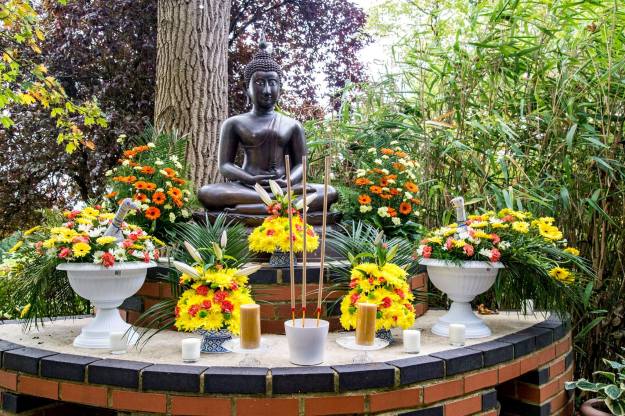
For many years now, September has meant for me one very important and unusual occasion, the Spring Hill Prison Buddha Grove Celebration. The Buddha Grove in HMP Spring Hill was built by prisoners for prisoners in 1992 and formally opened on a bitter October evening. After the ceremony the prisoners dispensed some soup that they had thoughtfully made to warm their guests. I, of course, didn’t have any but I suspect, though hot it might have been, delicious it probably wasn’t because some of the Thais present immediately asked if they could do the catering next year! And so they did and so they have ever since, with every few years a different group taking it on and only one year missed, right up to and including this September. Once again on Sunday the 16th we had a marvellous evening for our annual celebration of the Buddha Grove at HMP Springhill. Monks from five temples attended and contributed to the chanting. And as usual many Thai people gathered to offer the food, to give of their time and their culinary and flower arranging skills and to cook a Thai vegetarian meal for the entire prison and guests. We began the evening at the Buddha Grove with chanting and speeches.  Then after everyone had been to the dining hall and the food was over we returned to end the evening, as we always do, by processing three times around the Buddha Grove with candles, incense and flowers.

42278870_2189014977786639_4702312444008071168_o

Burma in January

IMG_0994A

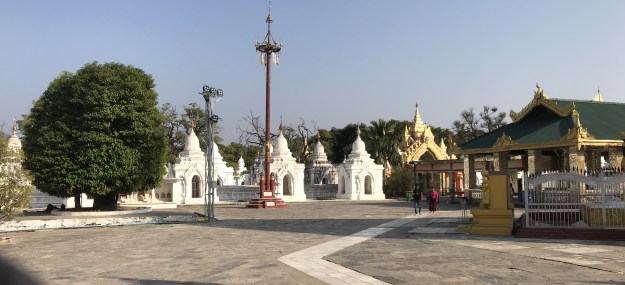
Kuthodaw Pagoda – containing the largest book in the world.

Now back to Burma. We left Ubon on January 17th immediately after the Ajahn Chah Memorial and drove down to Bangkok where we spent the night before flying to Mandalay the next day. There, our first stop once we’d checked in was a temple that proudly displays what it calls the largest book in the world, an extraordinary collection of 729 marble slabs on which were engraved over an eight year period from 1860 to 1868 the entire Tipitika, that is all the books of the Pali Canon, the oldest and earliest account of the Buddha’s life and teachings. It’s all in the Pali language and in Burmese script, and each slab is housed in its own mini temple, the whole collection covering 13 acres.

From there we drove out to a famous wooden bridge, U Bein’s Bridge. It’s almost three quarters of a mile long, rather peculiarly constructed and entirely of teak. It spans a huge lake which gradually dries up as after the rains the hot season advances. It’s one of several places in Burma to view spectacular sunsets and tourists armed with hugely expensive and complicated photographic paraphernalia flock here every evening to snap away. I’m afraid I deplore this craze to record everything instead of just being there. Time is a precious commodity, you know, and when you try to capture it, you miss it.

The next morning saw us at the old Royal Palace and once again I climbed the circular tower from where it is said that in 1885 Burma’s last Queen watched the British invading forces sailing up the Irrawaddy. Then in the afternoon we visited a few of the hundreds of temples clustered around the Sagaing Hill before a brief return to U Bein’s Bridge for the sunset and finally, as darkness fell, the Mahamuni Pagoda with its famed Mahamuni Image of the Buddha, the most revered in Myanmar.

Our third day was spent sailing down the Irrawaddy, previously known to the British colonialists and to Kipling as ‘the Road to Mandalay’. This is an enormous and majestic river and it’s a wonderful experience. We were on a smarter and faster boat than last year and it was only late afternoon when we pulled in to Bagan, home to a colossal number of ancient and mostly crumbling pagodas, just in time to check in to our hotel and walk down to a favourite riverside temple for yet another sunset. We stayed there as darkness fell and small oil lamps were lit along the terrace overlooking the river and around the pagoda. Unfortunately, on our boat down the river we’d been rather over exposed to the sun and I’d got badly burnt. I’m one of those fair skinned persons who can be cooked like a lobster and it’s not all that much fun when it happens. So, the next morning I was not at my best but on that, our fourth day, we did manage visits to some of the more prominent of Bagan’s two thousand odd pagodas before being dropped off at the airport in time for our flight to Yangon, formerly known as Rangoon and until a few years ago, the capital.

Here we stayed as in previous years at an hotel with a view of the Shwe Dagon Pagoda. This is a massive chedi, covered entirely in gold that sits on a small hill from where it dominates the entire city. It’s dedicated to the last four Buddhas and at each of the four cardinal points there is a temple and image of one of these four great beings. As you climb the stairs at one of the entrances it draws you on and as you emerge onto the piazza that surrounds it, it welcomes you. There you find all sorts: monks and nuns, lay people, tourists, children – all sorts – some walking and looking about them, some sitting telling their beads, some chanting, some meditating. It has a serenity and a life that’s addictive. We went there as soon as we’d arrived and stayed until closing time and early the next morning we were back there again.

Our five few days in this golden land were over all too soon. All that’s born must pass and our visit too had to come to an end but I hope we’ll be back again next year.


Magha Puja

March, this year, began with a full moon. It was also the full moon that concluded the ancient lunar month of Magha. On another Magha full moon, more than two and a half thousand years ago the Buddha was staying on the Vulture’s Peak near Rajgir. Below him was the Bamboo Grove, the very first piece of land offered as a place where he and his disciples might stay. Suddenly, without any kind of prior arrangement, a great company of monks began to gather at the Bamboo Grove. Within a short space of time one thousand, two hundred and fifty monks had arrived and were sitting there. Every one of these monks was not only a personal disciple of the Buddha and had been ordained by him but was also an Arahant, that is Enlightened. Once they were all assembled the Buddha came down from the Vulture’s Peak and joined them and together they sat silently meditating into the night. Eventually, the Buddha addressed them and recited for them what is known as the Ovada Patimokkha.

Only three short verses long, this summary of the Buddha’s Teaching contains one particular verse that I want to draw your attention to and ask you to remember and often bear in mind. In translation it goes something like this: ‘Avoid all evil, cultivate the good and purify the mind; this is the teaching of all the Buddhas.’ I hope its meaning is clear. Do your best to control what you say and do and try to make sure that your actions and words do no harm. Keep well away from what is unskilful and brings no peace or happiness and do your best to promote what is good and productive of happy results. Then reflect, is that really good enough? It’s all very well but if your control slips or you forget, what then? Well we all know what happens. It doesn’t take much for bad words to escape your mouth or for you to do things that later you regret. And why is this? Isn’t it because your mind is not yet pure and still harbours greed, hatred and delusion? So, then there can be nothing else for it, you have to go further, to the very root of your bad behaviour, to the very place where all suffering begins. You still mustn’t neglect to be careful of what you say and do, that foundation in virtue is enormously important – it’s just that it’s not enough. But the peace and stability morality brings does enable you to gradually still and watch your mind – and so begin to gain insight into how things change, and how unsatisfactory and insubstantial they are. Thus, by seeing and knowing the true nature of things, the mind is eventually cleansed of greed, hatred and delusion.

At the celebrations of events like Magha Puja and at any important occasion the lay people always ask for and then receive and reaffirm the Three Refuges and Five Precepts. Having only a moment ago been speaking of avoiding evil and cultivating what is good, to help you do just that I recommend those precepts and suggest that you recollect them frequently and make sure they’re with you always, wherever you go and whatever you’re doing. And especially the least popular, the fifth, abstinence from alcohol and drugs. I know some people say it’s intoxication that you must avoid and therefore a small amount socially is alright but that’s not what the texts say. You don’t have to be unable to walk – even a sip is a breach of the precept. There is a saying, ‘First the man takes a drink, then the drink takes a drink, then the drink takes the man!’ We don’t say of the other precepts that a little bit of killing is alright or a little bit of stealing. No! In this practice it’s vital that you make your mind clear – how else can you begin to really see things as they are? That’s why we meditate and so if you’re determined to develop your mind there should be no place in your life for drink or drugs.

The Ajahn Chah Memorial – his Centenary

27624572_10215046924837425_7868480550865176659_o

As many of you will know it’s been my habit for over twenty years to disappear to Thailand every January for around three weeks to attend the Ajahn Chah Memorial on the anniversary of his death. What hasn’t been my habit was to plan and book my trip well in advance but this time, since it was to be Ajahn Chah’s centenary year and a lot more people would be going, I thought I better had, so I did. But then as I’d always feared and why I don’t like planning too far ahead, the unexpected happened and I heard that on January 12th there was to be a ceremony at his birthplace where a gigantic stone pillar had been erected to mark the spot just a mile or so from Wat Pah Pong, his main temple. That was the day I was due to fly out but as soon as I heard this news I decided that I just had to be there for that. So, thankfully, I managed to change my booking to leave on the 10th – and then something else unexpected happened, I caught a very bad cold. So, it was all a bit touch and go. But never mind! I made it and on the morning of January 12th I took my seat at the ceremony marking the opening and the offering of this very special memorial at Venerable Ajahn Chah’s birthplace.

The three weeks that I was away fell into three distinct parts: first there were the few days in the NE of Thailand for Ajahn Chah’s Memorial; then five days in Burma, first in Mandalay, then a day on the Irrawaddy followed by Bagan and Rangoon; and finally, a week back in Thailand with a day or two in Bangkok and a rest on the coast at Ch’aam. For now, I’ll concentrate on the Ajahn Chah Memorial and report on the rest next month.

So, having arrived in Thailand in the afternoon of the 11th, I then flew on to Ubon and by the early evening I was safely settling in at a temple near Wat Pah Pong and being briefed about the programme for the following day. Next morning, soon after first light, we left to drive the few miles to Bahn Gaw, the village in which Ajahn Chah was born almost a hundred years ago. Arriving at the outskirts we left the cars and walked the remaining hundred yards to the site of his birthplace. There, now instead of the house in which he was born and the buildings that followed, there stands a twelve metre or forty foot high solid sandstone pillar with its crown fashioned to resemble a lotus bud.

Around it are sculpted stone railings with cement and stone friezes that depict scenes from Ajahn Chah’s life. 27500389_10215046912677121_6005404411821749273_oThe obvious inspiration for this impressive memorial ‘garden’ have been the huge stone pillars and stone railings erected by the Emperor Ashoka two thousand years ago in India to mark places of significance in the life of the Buddha. Those polished sandstone pillars, most of which have been broken, although one still stands at Vesali, were about fifteen metres tall. For this Ajahn Chah pillar, I was told it took three attempts by the quarry to extract an unbroken piece of stone large enough and then three days to transport it on the only vehicle in Thailand large enough for the job. Once erected and in position stone masons have spent the last four years working on it. Various monks have helped with the surrounding area and one, Luang Por Anek, has sculpted and crafted some of the stone work, particularly the two slabs you can see in the picture on either side of where I and the group are sitting. I think it’s a wonderful and hugely tasteful memorial to Ajahn Chah and like those Ashoka pillars I’m sure it will last for hundreds of years. And perhaps just like those Ashoka pillars, at some time in the distant future it will provide for future generations a clue that will lead them to learn of a remarkable man who rose from humble beginnings to live the Buddha’s message and in his own way teach and transform the lives of thousands all over the world. That’s what the Buddha’s teachings – and the example of people like Ajahn Chah – do, they change people utterly and for the better.

The birthplace ceremony was also the beginning of the five day event in remembrance of Ajahn Chah, for which thousands had gathered from all over the world. From the birthplace to Wat Pah Pong, the principal temple founded by Ajahn Chah, the road was lined with sunflowers and there were plenty more at Wat Pah Pong itself and around the Ajahn Chah Stupa. They were there to provide colour and decoration and in time, of course, an income for the good locals who had grown them.

Remember, I was still recovering from a nasty cold, so for the next three days I took it easy. On one day I did nothing much at all, on another just a drive and an easy walk through a large, wild forest temple where I lived for a year in 1973, and on another, first a visit to the free food stall sponsored and run by followers of The Forest Hermitage before a drive out to see an old friend and mentor who is in indifferent health but still manages to go on a long alms round every day in his electric wheelchair. I should have mentioned that to feed the thousands of devotees and hundreds of monks gathered at Wat Pah Pong, dozens, perhaps hundreds of food stalls dispensing free food were operating at all hours of the day and night.


Then came the 16th, the big day and the anniversary of Ajahn Chah’s passing in 1992. Every year since his funeral in ’93, the anniversary has been marked by a procession from the main meeting hall out to the stupa that houses his relics and then once the leading group have circled it and gridlock been achieved a tribute to Ajahn Chah is recited before we all place the symbolic offerings we’ve been carrying in or around the stupa. This year was much the same, only bigger because this year would have been his centenary and so the numbers were swollen with even more devotees from all over the world. It was, as always, a very moving occasion. Then in the evening that followed and through the night Dhamma talks were given in Thai and in English. Mine was in English.

And that was it. On the 17th it was all over, and people were rapidly dispersing to wherever they’d come from or to wherever they were going to next. For Ajahn Manapo and I it would be Burma next and so that afternoon we set off by car for Bangkok to be ready for our flight to Mandalay the next day.

The Sangha

In the Buddhist lunar calendar, each month ends on a full moon, and so on the full moon of Thursday, October 5th, the last of the three months of this year’s annual Vassa or Rains Retreat came to an end. On that full moon day each bhikkhu (Buddhist monk) so long as there is a quorum of five or more monks, must invite admonishment from the Sangha, or otherwise, if less than five, from however many monks are present. It’s an annual formality that reminds each monk that he’s in training and therefore will sometimes need help and correction. Because this is an important day for the Sangha, it’s the day we have chosen on which to celebrate the third of the Three Jewels, the Sangha; the other two, of course, being the Buddha and the Dhamma. In the suttas the word sangha, which literally means a group or community, is usually used in one of two ways: either it refers to the Samutti or conventional Sangha of ordained monks and nuns bhikkhus and bhikkhunisor to the Ariya Sangha of Noble Ones — persons who have realised one of the four stages of Awakening that commence with Stream-Entry. Those four stages are in fact a gradual and progressive peeling away of the ten fetters that bind us to the round of rebirth and perpetual suffering. Should you be fortunate enough to Enter the Stream that leads certainly to Enlightenment it will mean that the first three of those fetters, that include a belief in a self or personality, doubt and superstitious attachment to rites and rituals, have been overcome and discarded and you are bound within seven lifetimes at most to attain Enlightenment. Next comes the stage of Once Returner when a further two, sensual desire and ill-will, have been weakened and then you have only one more rebirth to endure. Thirdly, comes Non-Returner when those last two have been finally overcome and abandoned, then there is no more rebirth as a human. That leaves just five left to go, these are regarded as the higher fetters and therefore the more difficult to break free of. They are: the attachment to the realms of form and the formless realms, then conceit, agitation and ignorance. When they’re all gone, that’s when a person becomes an Arahant, an Enlightened One. These stages are clearly great achievements, not easily arrived at and therefore merit our admiration. Not only that, they are an inspiration and a reminder of what we could be doing. And so, whenever we recite a puja we recite not only the qualities of the Buddha and his Dhamma but also the qualities of this Noble Sangha. But let’s not forget the Samutti Sangha, the conventional Sangha, and its achievements and meaning for us. First of all, it is a source of stability and provides leadership and guidance. It has been in existence for a very long time, it stretches right back to the Buddha’s very first sermon. It was set up by the Buddha and during his lifetime he was constantly working with it and as things happened, refining and shaping it, and ensuring it remained fit for purpose – that of enabling one to make it from the hither shore to the farther shore, from Samsara to Nirvana, from bondage to freedom. And over the centuries the Sangha has guarded, cared for and against extraordinary odds maintained unadulterated, unspoilt, the Buddha’s essential message so that some 2.500 years later it is as clear as when first it was given. To this day, the Sangha continues to offer the opportunity for full-time training and practice. Yes, I know, it has had its ups and downs, and inevitably many of the ordinary mortals involved have lost and keep on losing their way but while the Sangha as an institution continues to exist, its great body of knowledge and experience along with what it stands for is not lost and remains to be used and regenerated. In both its forms the Sangha is a fabulous phenomenon and should be cherished.

An Angulimala Workshop with the Chief Inspector of Prisons

You may not know this but all the Buddhist prison chaplains are members of Angulimala, the Buddhist Prison Chaplaincy and four times a year we have a day together at The Forest Hermitage. Not all come every time but usually twenty or more spend the day here with me. We meditate together, some rather fine Thai food is provided by some of the Thai ladies who regularly come here and we have a chance to discuss both prison and Buddhist matters. For our meeting in September we were blessed with a lovely sunny day and held our meeting outside in our small marquee. That gave us the extra space we needed to comfortably accommodate a slightly larger gathering than usual attracted, no doubt, by the presence of the Chief Inspector of Prisons, Peter Clarke, who joined us for the afternoon. He’s a very nice man and generously gave us a good talk and answered a range of questions. When it was over I presented him with a copy of a new book that had been launched at a conference in Thailand that I had spoken at in May. Published by Mahachulalongkornrajavidyalaya University Press, it’s called Common Buddhist Text – Guidance and Insight from the Buddha and is an anthology of texts from the three main traditions of Theravada, Mahayana and Vajrayana Buddhism. It’s rather good and I’m hoping it could provide a basis for a general Buddhist curriculum within the prisons. I brought back a few copies and I’ve had some more sent so I could let all the chaplains present take a copy too. So, there we all are in the photo clutching our respective copies.